
Finance, Innovation and Collaboration Take Center Stage at Future Sustainability Forum 2023
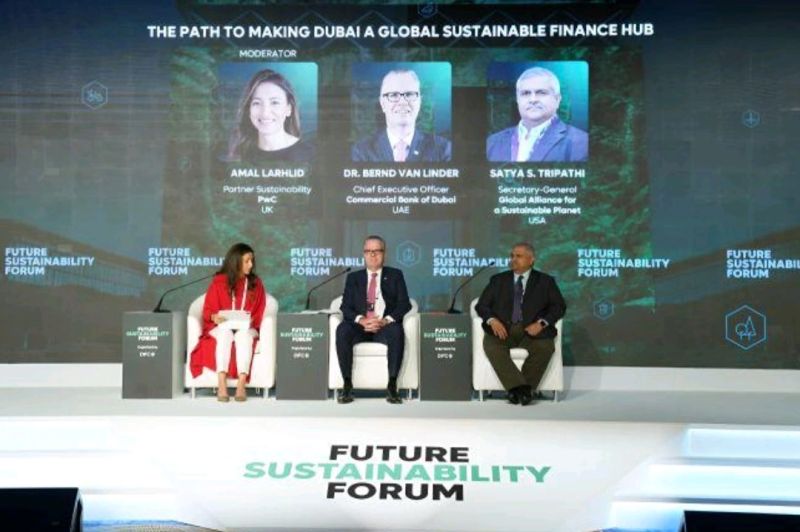
As the world races to address climate change and accelerate the transition toward a low-carbon economy, the role of financial institutions has never been more critical. Against this backdrop, the Future Sustainability Forum 2023 in Dubai hosted a thought-provoking fireside chat titled “The Path to Making Dubai a Global Sustainable Finance Hub,” bringing together some of the leading voices in sustainable finance and global development.
The session featured Dr. Bernd van Linder, Chief Executive Officer of Commercial Bank of Dubai, and Satya Tripathi, Secretary-General of the Global Alliance for a Sustainable Planet, with moderation by Amal Larhlid, Partner Sustainability at PwC. Held at the Ritz-Carlton, DIFC, the discussion explored how Dubai can strengthen its position as a global center for sustainable finance while supporting the broader objectives of climate action and economic transformation.
Dubai’s Opportunity in the Sustainability Era
The discussion highlighted that sustainability is no longer simply an environmental issue; it has become an economic imperative. Global investors are increasingly directing capital toward companies, projects, and markets that demonstrate strong environmental, social, and governance (ESG) credentials.
Dubai’s unique geographic position connecting Europe, Asia, and Africa gives it a strategic advantage in mobilizing sustainable investment flows between developed and emerging markets. Combined with its sophisticated financial infrastructure, progressive regulatory environment, and growing innovation ecosystem, the emirate is well positioned to become a leading gateway for sustainable capital.
Participants noted that the city’s vision aligns closely with the UAE’s broader sustainability ambitions, including the Net Zero 2050 initiative and the country’s commitment to accelerating climate action.
The Role of Financial Institutions
Dr. Bernd van Linder emphasized the responsibility of banks and financial institutions in supporting the transition to a greener economy. Financial institutions are uniquely positioned to influence business behavior through lending, investment decisions, and sustainability-linked financial products.
Commercial Bank of Dubai has actively advanced sustainable finance initiatives, including the development of a sustainable financing framework and green finance instruments designed to support environmentally responsible projects. Such initiatives demonstrate how banks can move beyond traditional financing models and become catalysts for positive environmental impact.
The discussion reinforced the idea that sustainable finance is no longer a niche segment but is rapidly becoming an integral part of mainstream banking and investment strategy.
Mobilising Capital at Scale
One of the central themes of the conversation was the enormous financing requirement needed to meet global climate objectives. Trillions of dollars in annual investment will be required to achieve net-zero goals, strengthen climate resilience, and support sustainable development worldwide.
Satya Tripathi highlighted that unlocking this capital will require unprecedented levels of collaboration between governments, financial institutions, development organizations, and the private sector. Public resources alone cannot finance the transition. Instead, innovative financial mechanisms must be developed to attract private investment into sustainable projects and climate solutions.
The speakers stressed that finance must move from being a passive observer of sustainability challenges to becoming an active enabler of solutions.
ESG as a Driver of Competitiveness
The conversation also explored the growing importance of ESG integration across industries. Companies that successfully embed sustainability into their business models are increasingly viewed as more resilient, attractive to investors, and better positioned for long-term success.
For Dubai, strengthening ESG adoption across its corporate and financial sectors will be essential in maintaining global competitiveness. Investors are placing greater emphasis on transparency, accountability, and measurable sustainability outcomes when making capital allocation decisions.
The speakers agreed that ESG should not be viewed as a compliance exercise but rather as a strategic opportunity to create value and drive innovation.
Building an Ecosystem for Sustainable Growth
Beyond finance, the panel emphasized the importance of creating a broader ecosystem that supports sustainability-driven innovation. This includes fostering climate technology startups, supporting research and development, encouraging green entrepreneurship, and building partnerships across industries.
Dubai’s growing focus on innovation, digital transformation, artificial intelligence, and sustainable infrastructure creates favorable conditions for developing new solutions that address environmental challenges while generating economic growth.
The city is increasingly emerging as a platform where finance, technology, and sustainability converge to create scalable solutions for global challenges.
Looking Ahead
The fireside chat concluded with a clear message: the transition to a sustainable future presents not only challenges but also significant opportunities. Financial centers that successfully mobilize capital, encourage innovation, and foster collaboration will play a defining role in shaping the global economy of the future.
As Dubai continues to strengthen its sustainable finance ecosystem, initiatives such as the Future Sustainability Forum provide an important platform for dialogue, partnership, and action. The discussion between Dr. Bernd van Linder and Satya Tripathi demonstrated that achieving sustainability goals will require collective effort, visionary leadership, and a financial system capable of supporting long-term transformation.
With strong institutional support, growing investor interest, and a clear strategic vision, Dubai is increasingly positioning itself as a leading global hub for sustainable finance and climate-focused investment.





