The Southern African Development Community (SADC) is advancing efforts to strengthen regional investment by developing a more integrated and interconnected capital market capable of mobilising domestic, regional and international capital.
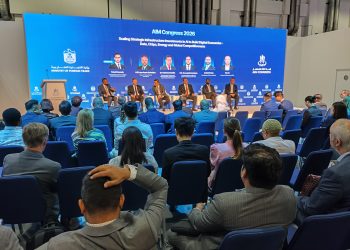
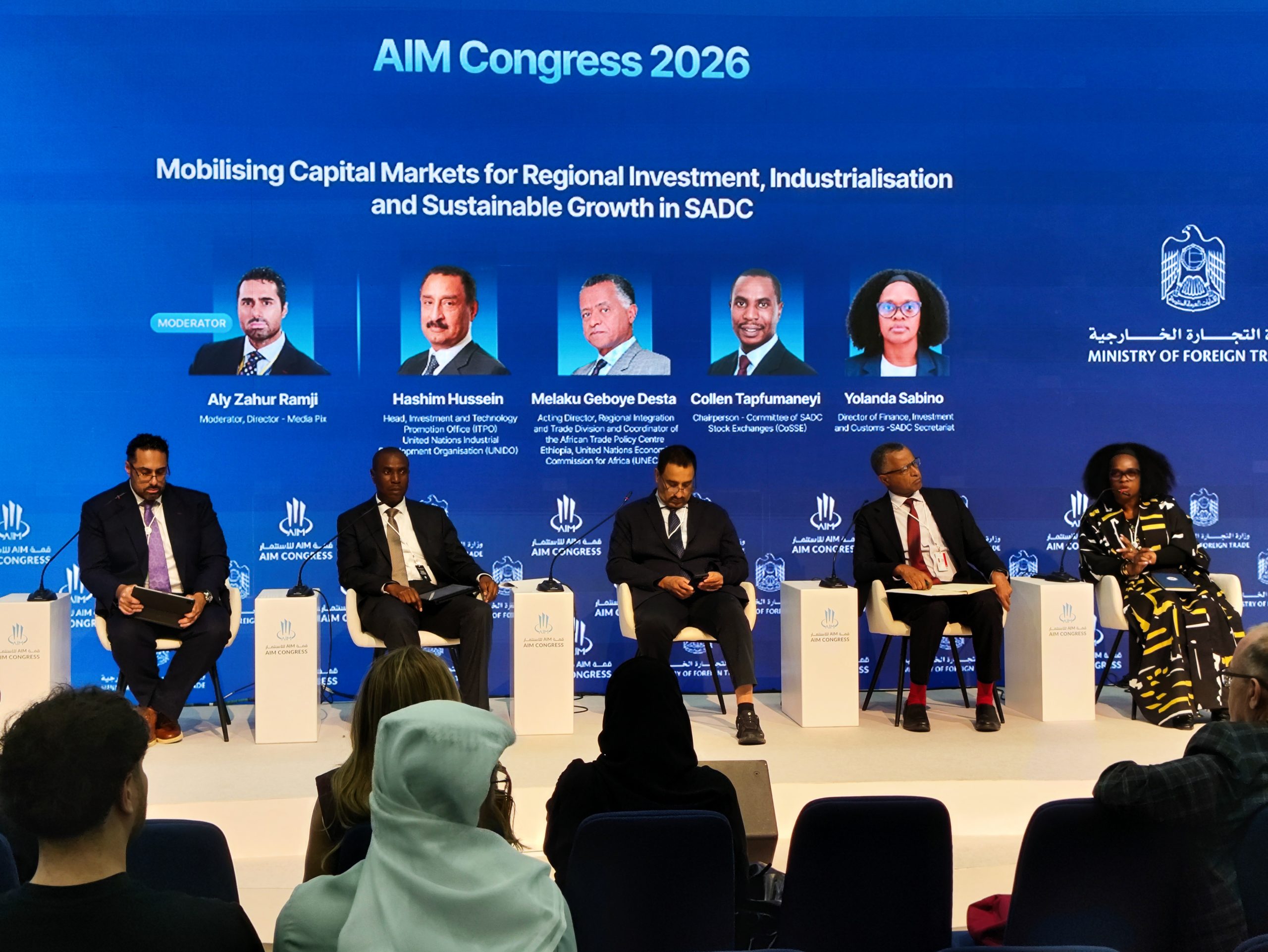
The issue was highlighted at AIM Congress 2026 in Dubai during a session titled “Mobilising Capital Markets for Regional Investment, Industrialisation and Sustainable Growth in SADC.” The session brought together representatives from regional institutions, capital markets and international development organisations to examine how stronger financial-market connectivity can support Southern Africa’s long-term development ambitions.
The discussion was moderated by Aly Ramji, Director of Mediapix Limited, and featured Hashim Suleiman H Mohamed, Head at the United Nations Industrial Development Organisation (UNIDO); Melaku Geboye Desta, Acting Director of the Regional Integration and Trade Division and Coordinator of the African Trade Policy Centre at the United Nations Economic Commission for Africa (UNECA); Collen Tapfumaneyi, Chairperson of the Committee of SADC Stock Exchanges (CoSSE); and Yolanda De Figueredo Sabino, Director of Finance, Investment and Customs at the SADC Secretariat.
A Regional Development Agenda
SADC’s long-term development agenda is guided by SADC Vision 2050 and the Regional Indicative Strategic Development Plan (RISDP) 2020–2030).
The priorities cover a broad range of sectors, including infrastructure, energy security, industrialisation, climate resilience, digital transformation, tourism, regional value chains and human capital development.
Delivering these objectives requires significant long-term investment. While governments and development-finance institutions remain important sources of funding, deeper and more efficient capital markets can provide additional channels for financing businesses, infrastructure and strategic development projects.
The development of regional financial markets is therefore becoming an important component of Southern Africa’s economic transformation.
Connecting SADC’s Capital Markets
At the centre of this process is the Committee of SADC Stock Exchanges (CoSSE) Interconnectivity Project.
The initiative is designed to progressively connect SADC stock exchanges through a Smart Order Router (SOR) framework, helping create greater connectivity between participating capital markets.
Greater interconnection can make it easier for investors to access securities and opportunities across participating markets while supporting improved liquidity and market efficiency.
Rather than operating as entirely separate national markets, interconnected exchanges can provide the foundations for a broader regional investment ecosystem.
Opening New Channels for International Capital
The development of an integrated regional capital market has significance beyond financial-market infrastructure.
For international investors, greater connectivity can make Southern African markets easier to access and understand as part of a wider regional investment strategy.
A more connected market can help provide investors with broader opportunities across sectors and countries while enabling businesses to reach a larger pool of potential capital.
This is particularly important as international investors increasingly seek opportunities in emerging and developing markets with strong long-term growth potential.
Supporting Industrialisation
Capital-market development also has an important role to play in supporting industrialisation.
Southern African economies have opportunities to expand manufacturing, processing and regional production while strengthening value chains across borders.
Access to capital can support companies seeking to expand production, invest in technology, improve infrastructure and develop new products and services.
Regional financial integration can further support this process by creating opportunities for businesses to access capital beyond their domestic markets.
As regional value chains develop, stronger financial connectivity can help support companies at different stages of the investment and growth cycle.
Infrastructure and Energy Investment
Infrastructure remains another major investment opportunity across SADC.
Transport networks, logistics infrastructure, energy generation and distribution, telecommunications and digital infrastructure are essential to improving regional connectivity and supporting economic activity.
Energy security is particularly important for industrial development. Reliable and sustainable energy infrastructure can improve the operating environment for businesses while supporting new investment.
Mobilising private and institutional capital alongside public investment can help expand the resources available for these large-scale projects.
Sustainable Growth and Climate Resilience
The session also placed capital-market development within the broader context of sustainable economic growth.
Climate resilience is becoming increasingly important for governments, businesses and investors. Financing mechanisms that support sustainable infrastructure, clean energy and climate-resilient projects can contribute to long-term economic stability.
For SADC, sustainable investment can also create opportunities to modernise infrastructure and industries while addressing environmental and social priorities.
This creates a potential alignment between development objectives and the growing global demand for sustainable investment opportunities.
The Importance of Regional Integration
Regional integration provides the foundation for many of these opportunities.
Trade agreements, financial-market reforms and improved payment and settlement systems can make it easier for businesses and investors to operate across national borders.
The SADC Free Trade Area, the Protocol on Finance and Investment, the SADC Real-Time Gross Settlement System and initiatives aimed at capital-market harmonisation are examples of efforts to strengthen regional economic connectivity.
Together, these initiatives can contribute to a more integrated business environment in which capital and commercial activity can move more efficiently across the region.
Positioning Southern Africa for Global Investors
The emerging regional investment framework presents SADC as more than a collection of individual national markets.
A progressively interconnected capital market can offer international investors a broader gateway into Southern Africa while providing regional businesses with greater access to investment.
AIM Congress 2026 provided an international platform for presenting this investment proposition to investors, financial institutions, governments and development organisations.
The combination of infrastructure needs, industrialisation opportunities, natural resources, emerging technologies and growing regional markets creates a diverse investment landscape.
A New Chapter for Regional Capital
The development of SADC’s capital markets represents an important step towards strengthening the region’s capacity to finance its own development while attracting international investment.
Greater stock-exchange connectivity, stronger financial infrastructure and regional market integration can help create a more accessible and efficient investment environment.
As SADC continues implementing its Vision 2050 and RISDP 2020–2030 priorities, capital-market integration can become an important tool for supporting industrialisation, infrastructure development and sustainable growth.
The message emerging from AIM Congress 2026 is one of opportunity: by connecting markets, strengthening regional institutions and improving access to capital, Southern Africa can build a stronger platform for investment and create new pathways for businesses, investors and communities across the region.