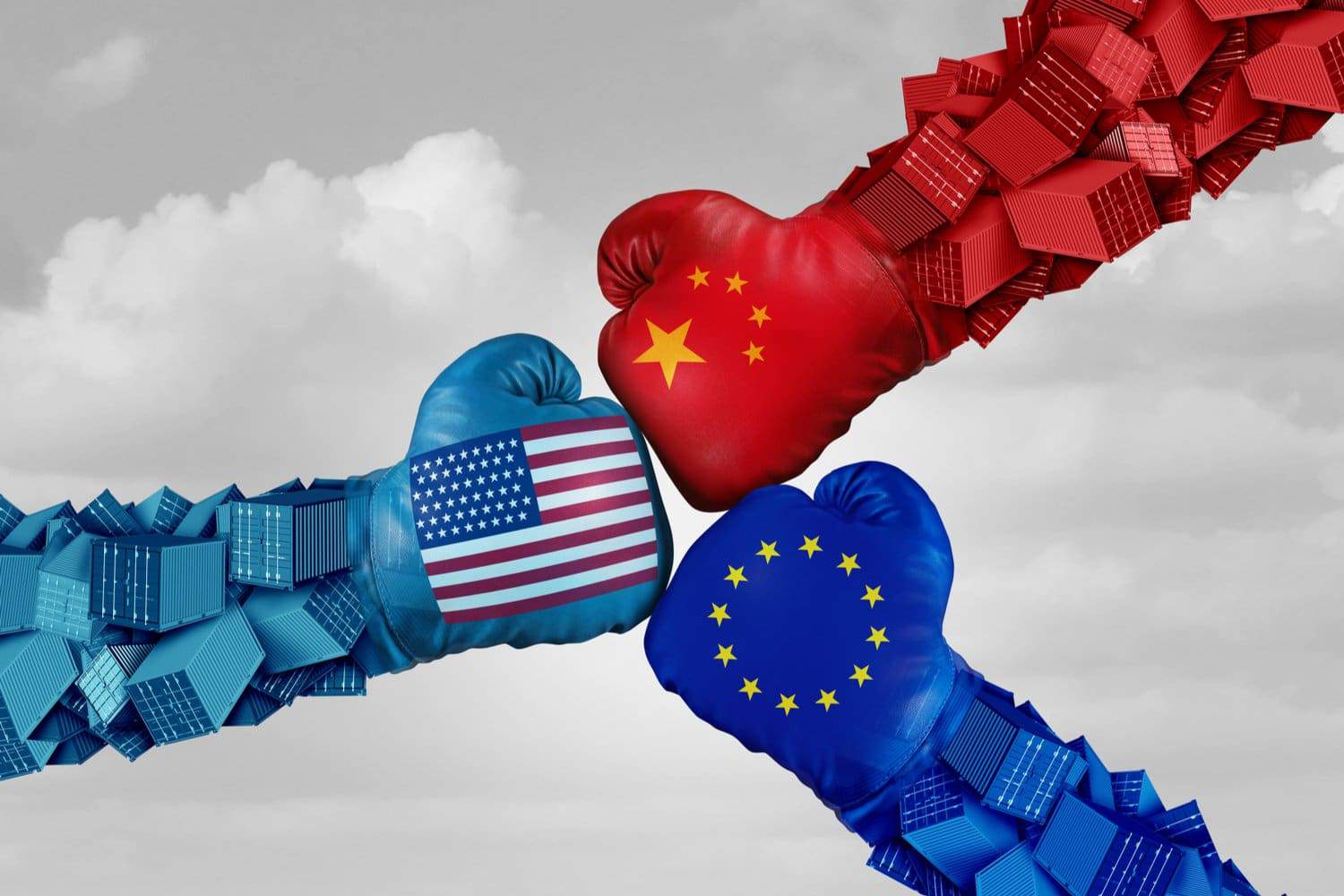
By 2026, technological competition has evolved into a defining axis of global power. Artificial intelligence and blockchain technologies are no longer niche sectors confined to startups and research labs; they are strategic assets shaping economic sovereignty, military capability, and geopolitical leverage.
At the center of this contest stand three giants: the United States, China, and the European Union. Each approaches artificial intelligence and blockchain with distinct political systems, regulatory philosophies, capital markets, and strategic ambitions.
The pressing question is simple but profound: Who will dominate?
The answer, however, resists simplicity.
The United States: Innovation and Capital Powerhouse
The United States entered the AI race with structural advantages that are difficult to replicate. Its combination of leading research universities, venture capital ecosystems, and entrepreneurial culture has consistently translated breakthrough science into global platforms.
Companies such as OpenAI, Google, Microsoft, Meta, and NVIDIA form an integrated AI superstructure. NVIDIA supplies advanced semiconductors; OpenAI and Google develop frontier models; Microsoft commercializes enterprise solutions at scale.
The American advantage lies in three dimensions:
- Frontier Model Leadership
The most advanced large language models and multimodal AI systems have largely emerged from U.S.-based firms. Their ability to attract global research talent reinforces that lead. - Venture Capital Scale
American venture capital remains unmatched in scale and risk appetite. Early-stage AI and blockchain startups receive funding quickly, enabling rapid iteration. - Military-Industrial Integration
AI development intersects with defense modernization. U.S. defense agencies maintain deep partnerships with tech firms, accelerating dual-use innovation.
In blockchain, the United States also hosts major cryptocurrency infrastructure, exchanges, and developer communities. Despite regulatory tensions, it remains a global center for digital asset investment.
Yet weaknesses exist. Regulatory fragmentation between federal and state authorities creates uncertainty in crypto markets. Export controls on advanced AI chips reflect geopolitical concerns but also risk accelerating competitors’ self-sufficiency.
Still, in raw innovation intensity, the U.S. currently leads.
China: Strategic Coordination and State Power
China’s model differs fundamentally. Where the United States relies on decentralized private innovation, China integrates state planning with corporate execution.
Technology giants such as Baidu, Alibaba, and Tencent anchor its AI ecosystem. Their platforms operate at vast domestic scale, generating enormous datasets that fuel machine learning systems.
China’s advantages include:
- Centralized Strategic Direction
AI is embedded within long-term national policy frameworks. Beijing designates emerging technologies as core to economic modernization and national security. - Manufacturing Dominance
China’s control over supply chains in electronics and hardware provides leverage in applied AI systems, robotics, and smart infrastructure. - Digital Currency Leadership
Through the digital yuan initiative, China has moved faster than many Western nations in deploying a state-backed digital currency. While distinct from decentralized blockchain, it demonstrates institutional comfort with digital ledger technologies.
However, China faces structural challenges.
U.S. export restrictions on advanced semiconductors constrain access to cutting-edge chips required for training large AI models. Although domestic firms are racing to develop substitutes, the gap remains significant.
Additionally, strict regulatory oversight and political control can dampen entrepreneurial risk-taking compared to American venture environments.
In blockchain, China has curtailed speculative cryptocurrency trading domestically while encouraging enterprise blockchain applications. This selective embrace underscores a preference for controlled technological sovereignty rather than open decentralized ecosystems.
The European Union: Regulation as Power
The European Union presents a third model: normative leadership through regulation.
Unlike the U.S. or China, the EU lacks tech giants of comparable global scale in AI infrastructure. Yet it exerts influence through regulatory frameworks that often shape global standards.
The EU’s Artificial Intelligence Act seeks to establish risk-based governance for AI deployment. In blockchain and digital assets, European regulators have advanced harmonized frameworks to create legal clarity across member states.
The EU’s strengths include:
- Regulatory Standard-Setting
The “Brussels Effect” enables European standards to influence global companies seeking access to its single market. - Privacy and Ethics Leadership
European policy emphasizes data protection and human rights safeguards, differentiating its AI model from both American market liberalism and Chinese state centralism. - Industrial Integration
European firms apply AI in advanced manufacturing, automotive engineering, and green energy transition sectors.
However, Europe faces critical weaknesses.
Fragmented capital markets limit the scale of venture funding compared to Silicon Valley. Talent often migrates to U.S. firms offering higher compensation and research autonomy. And while regulation fosters safety, excessive bureaucracy risks slowing innovation.
In blockchain adoption, Europe has embraced digital assets more cautiously than the U.S., yet more openly than China. Its challenge remains translating regulatory clarity into global technological leadership.
AI vs. Blockchain: Different Battlefields
Although often discussed together, AI and blockchain represent distinct technological theaters.
Artificial intelligence demands immense computational resources, data concentration, and semiconductor dominance. Blockchain emphasizes decentralization, cryptographic security, and financial architecture.
In AI hardware and advanced models, the United States currently commands the lead through NVIDIA’s chip dominance and research hubs clustered around Silicon Valley.
In data scale and state-coordinated implementation, China holds structural advantages, especially in smart cities and digital infrastructure deployment.
In governance and global regulatory shaping, the European Union exerts outsized influence relative to its corporate footprint.
Blockchain dominance presents a more fragmented picture. The U.S. hosts much of the innovation capital and decentralized crypto ecosystems. China focuses on state-driven digital currency experiments and enterprise blockchain control. Europe emphasizes regulatory legitimacy.
No single region fully dominates both fields simultaneously.
Geopolitics and the Fragmented Future
The competition is increasingly shaped by geopolitics rather than pure market logic.
Export controls, semiconductor supply chains, cybersecurity policies, and digital sovereignty laws divide technological spheres of influence. Instead of a unified global digital economy, multiple semi-autonomous ecosystems may emerge.
The United States seeks to maintain technological primacy through alliances and industrial policy. China aims for strategic autonomy and reduced dependence on Western technologies. Europe aims to ensure technology aligns with democratic norms and citizen protections.
Domination in this context may not mean universal global leadership. It may mean leadership within aligned blocs.
So, Who Will Dominate?
If dominance is defined by frontier AI model capability and venture dynamism, the United States currently leads.
If dominance is defined by state-coordinated digital infrastructure and rapid societal-scale deployment, China presents formidable strength.
If dominance is defined by regulatory frameworks shaping global operational standards, the European Union wields quiet but significant power.
Long-term trajectories will depend on three variables:
- Semiconductor Self-Sufficiency
AI leadership hinges on advanced chips. Supply chain control will determine computational advantage. - Talent Flows
The region that attracts and retains top AI researchers and cryptographers will shape innovation curves. - Political Stability and Trust
Technological dominance requires public legitimacy. Excessive surveillance or unregulated chaos could undermine long-term credibility.
The Likely Outcome: Multipolar Technological Power
Rather than a single global winner, the world may enter an era of technological multipolarity.
The United States may dominate frontier innovation. China may excel in state-integrated implementation. The European Union may define regulatory boundaries that constrain both.
In blockchain, decentralized networks themselves resist geographic capture. Innovation may cluster globally rather than remain tied to national borders.
The 21st-century contest in AI and blockchain is not merely economic — it is ideological. It reflects competing visions of governance, privacy, sovereignty, and market freedom.
Domination, therefore, may not be absolute.
It will be negotiated — across supply chains, standards bodies, research labs, and global markets.
The race is ongoing. The landscape is shifting. And in technology, history has repeatedly shown that today’s leader is not guaranteed tomorrow’s supremacy.
The world is not watching a single winner emerge.
It is witnessing the birth of a multipolar digital order.