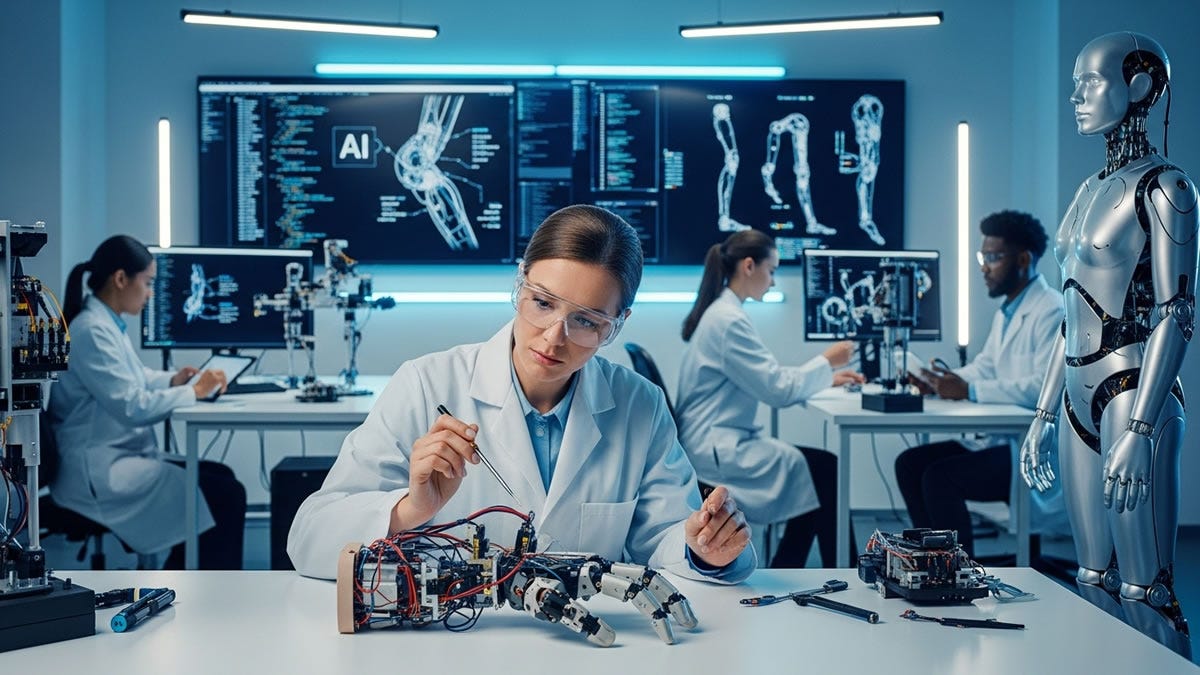
In laboratories from Silicon Valley to Shenzhen, a new kind of machine is learning to walk, grasp, observe, and even converse. These machines—humanoid robots designed to resemble the human body in structure and movement—are no longer confined to science fiction or research demonstrations. They are steadily entering real-world environments: warehouses, hospitals, homes, and public spaces. As their capabilities evolve, humanoids are forcing society to confront a profound question: what happens when machines no longer just assist human life, but begin to mirror it?
The idea of humanoid robots is not new. For decades, engineers have pursued the dream of building machines that can operate in human environments without requiring specialized infrastructure. The logic is straightforward: the world is designed for human bodies—door handles, staircases, tools, vehicles—so a machine shaped like a human can, in theory, navigate that world more easily than a wheeled or industrial robot. Yet the true ambition extends beyond convenience. Humanoids are a convergence point for multiple technological revolutions: artificial intelligence, advanced materials, biomechanics, and human-computer interaction. Their rise signals not just a new category of machine, but a shift in how humans relate to technology itself.
Recent advancements have accelerated this transition from concept to reality. Improvements in AI—particularly in machine learning and large language models—have given robots the ability to process language, recognize objects, and make decisions in dynamic environments. At the same time, breakthroughs in sensors, actuators, and battery systems have made movement more fluid and energy-efficient. Companies such as Blockchainarmy,Tesla, Boston Dynamics, and various startups are investing heavily in humanoid platforms, aiming to deploy them at scale within the next decade. The narrative has shifted from “if” humanoids will become common to “how soon” and “under what conditions.”
One of the most immediate applications of humanoid robots lies in labor. Across many industries, there is a growing mismatch between the demand for workers and the supply of willing or able participants. Aging populations in developed countries, combined with declining birth rates, have created labor shortages in sectors such as manufacturing, logistics, and elder care. Humanoid robots are often presented as a solution: tireless workers capable of performing repetitive or physically demanding tasks without fatigue.
In warehouses, for instance, humanoids could replace or augment human workers by picking, sorting, and transporting goods. In construction, they might handle dangerous tasks such as working at heights or in hazardous environments. In healthcare, they could assist nurses by lifting patients, delivering supplies, or monitoring vital signs. The appeal is clear: increased efficiency, reduced costs, and improved safety. But this vision also raises concerns about displacement. If humanoids can perform a wide range of tasks traditionally done by humans, what happens to the workforce?
The history of automation offers some clues but no definitive answers. Previous technological revolutions—from the mechanization of agriculture to the rise of computers—have eliminated certain jobs while creating new ones. However, humanoids differ in a crucial way: their versatility. Unlike specialized machines that perform a single function, humanoids are designed to adapt across tasks and environments. This flexibility could accelerate job displacement across multiple sectors simultaneously, potentially outpacing the creation of new roles.
Yet focusing solely on job loss risks oversimplifying the broader picture. Humanoids may also enable entirely new industries and forms of work. Just as the internet gave rise to digital marketing, app development, and remote collaboration, humanoid robotics could create demand for robot trainers, maintenance specialists, ethicists, and designers of human-robot interactions. The challenge for policymakers and educators will be to anticipate these shifts and prepare the workforce accordingly.
Beyond economics, humanoids raise deeper questions about human identity and social interaction. A machine that looks and behaves like a human invites a fundamentally different response than one that does not. Studies in psychology and robotics have shown that people tend to anthropomorphize humanoid machines, attributing emotions, intentions, and even moral status to them. This tendency can be both beneficial and problematic.
On one hand, humanoid robots could provide companionship and support, particularly for vulnerable populations such as the elderly or individuals with disabilities. In a world where loneliness is increasingly recognized as a public health issue, socially interactive robots might offer a form of connection that is accessible and consistent. They could remind patients to take medication, engage in conversation, or provide cognitive stimulation.
On the other hand, the illusion of companionship raises ethical concerns. If a robot simulates empathy without actually experiencing it, is the relationship authentic? Could reliance on humanoid companions reduce human-to-human interaction, potentially deepening social isolation rather than alleviating it? There is also the risk of manipulation. A humanoid designed to appear trustworthy could influence behavior in subtle ways, whether in commercial settings, political contexts, or personal relationships.
These concerns highlight the importance of transparency and design ethics. Developers must carefully consider how humanoids present themselves and what expectations they create. Should robots explicitly disclose their artificial nature at all times? Should there be limits on how human-like they can appear or behave? These are not merely technical questions; they are societal decisions that will shape the norms of human-robot coexistence.
Another critical dimension is governance. As humanoids become more capable, questions of responsibility and accountability become increasingly complex. If a humanoid robot causes harm—whether through malfunction, misuse, or autonomous decision-making—who is responsible? The manufacturer, the operator, the software developer, or the owner? Existing legal frameworks are not fully equipped to address these scenarios, particularly when AI systems operate with a degree of autonomy.
Regulation will need to strike a delicate balance. Overly restrictive policies could stifle innovation and limit the potential benefits of humanoid technology. At the same time, insufficient oversight could lead to safety risks, ethical violations, and public backlash. International coordination may also be necessary, as the development and deployment of humanoids are global in scope. Without shared standards, disparities in regulation could create uneven playing fields and unintended consequences.
Security is another area of concern. A humanoid robot is, in essence, a networked computer with physical capabilities. This makes it a potential target for hacking or malicious use. A compromised humanoid could pose risks not only to data privacy but also to physical safety. Ensuring robust cybersecurity measures will be essential to building trust in these systems.
Environmental considerations should not be overlooked. The production and operation of humanoid robots require resources, including rare materials and energy. While they may contribute to efficiency in certain sectors, their overall environmental impact will depend on how they are designed, manufactured, and integrated into existing systems. Sustainable practices will be crucial to ensuring that the benefits of humanoids do not come at an unacceptable ecological cost.
Despite these challenges, the potential advantages of humanoid robots are significant. In disaster response, they could enter areas too dangerous for humans, such as collapsed buildings or contaminated zones, to search for survivors or assess damage. In space exploration, humanoids could perform tasks on the surfaces of other planets, reducing the risks to human astronauts. In education, they could serve as interactive teaching assistants, adapting to individual learning styles and providing personalized support.
The cultural impact of humanoids is also worth considering. Throughout history, technological innovations have influenced art, literature, and philosophy. Humanoid robots are likely to inspire new forms of creative expression and provoke fresh reflections on what it means to be human. As machines become more human-like, the boundary between human and artificial intelligence may become less distinct, challenging long-held assumptions about consciousness, agency, and identity.
Ultimately, the future of humanoids will not be determined by technology alone. It will be shaped by the choices societies make about how to develop, deploy, and regulate these machines. Public engagement will be essential. People need to understand not only what humanoids can do, but also what they cannot—and what they should not. Open dialogue between technologists, policymakers, ethicists, and the broader public can help ensure that the trajectory of humanoid development aligns with shared values and priorities.
There is also a need for humility. Predictions about the future of technology are often overly optimistic in the short term and overly pessimistic in the long term. Humanoid robots may not transform society overnight, but their gradual integration could have profound cumulative effects. Recognizing both the possibilities and the limitations of current technology can help ground expectations and guide responsible progress.
In the end, humanoid robots represent a mirror as much as a machine. They reflect human ingenuity, ambition, and curiosity—but also human anxieties and contradictions. The desire to create machines in our own image speaks to a deeper impulse to understand ourselves. As humanoids become more capable and more present in everyday life, they will challenge us to reconsider what distinguishes humans from the technologies we create.
The future with humanoids is neither inherently utopian nor dystopian. It is contingent. It depends on how these machines are designed, how they are used, and how society adapts to their presence. If approached thoughtfully, humanoids could enhance human capabilities, improve quality of life, and open new frontiers of possibility. If mishandled, they could exacerbate inequalities, erode trust, and create new forms of risk.
The path forward requires careful navigation—balancing innovation with responsibility, efficiency with equity, and technological advancement with ethical reflection. In doing so, humanity has an opportunity not only to shape the future of humanoids, but also to define the kind of future it wants for itself.