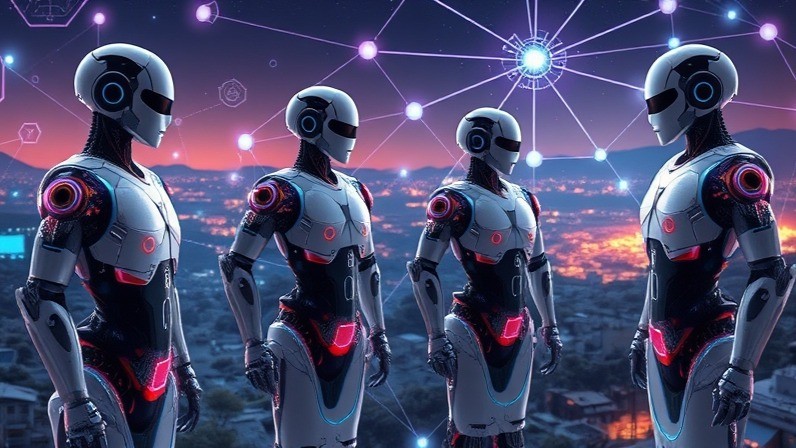
Across the world, in a logistics hub in the United States, another humanoid stacks packages, guided by computer vision and real-time data. Meanwhile, invisible to most observers, blockchain networks continue to validate transactions, secure identities, and maintain decentralized records across continents. Each of these developments represents a frontier of modern technology. Together, they signal something more profound: a transformation in how interaction itself is defined in an increasingly machine-augmented world.
The convergence of humanoid robotics, artificial intelligence (AI), and blockchain technology is not simply a matter of technological overlap. It represents a shift toward systems that are embodied, intelligent, and trust-enabled. In such systems, interaction is no longer limited to human-to-human or human-to-machine exchanges mediated by simple commands. Instead, it becomes a dynamic process involving perception, decision-making, verification, and accountability—often occurring simultaneously and autonomously.
Humanoid robots occupy a unique position in this convergence. Unlike traditional machines, they are designed to operate within human environments using familiar forms and behaviors. Their physical resemblance to humans—two arms, two legs, a head capable of orientation—allows them to navigate spaces built for people. More importantly, it shapes how humans respond to them. A humanoid robot does not just perform tasks; it invites interaction. It can gesture, maintain eye contact, and modulate its tone, creating a sense of presence that other machines lack.
Artificial intelligence is the cognitive engine behind this presence. Advances in machine learning, natural language processing, and computer vision have enabled humanoids to interpret speech, recognize faces, and adapt to changing environments. These capabilities allow for more natural interactions. A humanoid can understand not just what is being said, but how it is being said, adjusting its responses accordingly. It can learn from past interactions, refining its behavior over time.
Yet intelligence alone is not enough to sustain complex interactions, especially in contexts that require trust. This is where blockchain enters the picture. As a decentralized and tamper-resistant ledger, blockchain provides a framework for recording actions, verifying identities, and enforcing agreements without relying on centralized authorities. When integrated with humanoid systems, it introduces a new layer of interaction—one grounded in verifiability and transparency.
To understand the significance of this integration, consider the nature of trust in human interactions. Trust is often implicit, built over time through experience and reinforced by institutions such as governments, banks, and legal systems. In interactions with machines, however, trust is more fragile. Users must rely on the assumption that the system will function as intended, without always having visibility into its processes. This becomes increasingly problematic as machines gain autonomy.
Blockchain offers a way to externalize trust, embedding it into the system itself. For humanoid robots, this means that their actions can be recorded and verified in a way that is accessible and immutable. In a healthcare setting, for example, a humanoid assisting with patient care could log each action—administering medication, updating records, responding to emergencies—on a blockchain. This creates a transparent history that can be reviewed by medical professionals, regulators, and even patients’ families.
Such transparency has the potential to transform interaction by reducing uncertainty. When users know that a system’s actions are being recorded and can be audited, they may be more willing to engage with it. This is particularly important in sensitive contexts, where the stakes are high and the margin for error is small.
However, the integration of humanoids, AI, and blockchain is not without its challenges. One of the most complex issues is identity. In a decentralized system, identity is a key component of interaction. It determines who is authorized to perform certain actions and under what conditions. For humans, identity is tied to legal frameworks and social norms. For humanoid robots, it must be constructed digitally.
Blockchain enables the concept of decentralized identity, where entities can manage their own credentials without relying on a central authority. Applying this to humanoids raises intriguing possibilities. Each robot could have a unique digital identity, linked to its hardware, software, and operational history. This identity could be used to authenticate interactions, track performance, and establish accountability.
But this also raises difficult questions. Who owns a robot’s identity? Is it the manufacturer, the operator, or the end user? Can a robot have a form of “reputation” based on its actions, and if so, how is that reputation managed? These questions are not merely technical—they touch on legal and ethical considerations that have yet to be fully addressed.
Another critical dimension is the nature of economic interaction. Blockchain technology has already enabled the rise of decentralized finance and smart contracts—self-executing agreements that operate without intermediaries. When combined with humanoid robots, this opens the door to machine-to-machine (M2M) economies.
In such a system, humanoids could perform tasks and receive compensation automatically. A service robot might clean a space, verify completion through sensors, and trigger payment via a smart contract. The entire process—from task assignment to payment—could occur without direct human involvement. This creates a new form of interaction, where machines are not just tools, but economic agents.
While this may increase efficiency, it also complicates traditional notions of labor and value. If machines can earn and transact, how are their activities regulated? Who is responsible for their economic behavior? And how does this impact human workers, particularly in industries where automation is already reshaping employment?
Social interaction presents another layer of complexity. Humans are inherently social beings, and the design of humanoid robots taps into this instinct. A robot that can smile, nod, and respond empathetically creates a sense of connection that goes beyond functionality. When powered by AI, these interactions can become highly personalized, adapting to individual preferences and emotional states.
Blockchain can play a role here as well, particularly in managing data and consent. Personalized interactions require data—about habits, preferences, and behaviors. Blockchain can provide a mechanism for users to control access to this data, granting permissions in a transparent and secure manner. This could empower individuals, giving them greater agency in how they interact with humanoid systems.
However, there is a tension between personalization and privacy. The more a system knows about a user, the more effective it can be—but also the more intrusive it may become. Recording interactions on a blockchain adds another layer of complexity. While the data may be secure, its permanence raises questions about long-term privacy and data ownership.
Security is another critical concern. A humanoid robot integrated with AI and blockchain is part of a broader digital ecosystem. This makes it a potential target for cyberattacks. A compromised robot could not only leak sensitive information but also perform harmful physical actions. Ensuring the security of these systems requires a multi-layered approach, addressing vulnerabilities in hardware, software, and network infrastructure.
The environmental impact of this convergence cannot be ignored. Blockchain networks, particularly those that rely on energy-intensive consensus mechanisms, have been criticized for their carbon footprint. At the same time, the production and operation of humanoid robots require significant resources. Balancing technological advancement with sustainability will be a key challenge in the years ahead.
Despite these challenges, the potential benefits are substantial. In disaster response, humanoid robots could operate in hazardous environments, coordinating with blockchain-based systems to log actions and share data in real time. In education, they could serve as interactive tutors, with blockchain ensuring the integrity of credentials and learning records. In public services, they could assist with everything from transportation to administration, operating within transparent and accountable frameworks.
The broader impact of this convergence lies in how it reshapes the concept of interaction itself. Traditionally, interaction has been understood as a direct exchange between two parties. In a world of humanoids, AI, and blockchain, interaction becomes a networked process, involving multiple layers of verification, decision-making, and feedback.
This shift has implications for governance as well. As these systems become more integrated into daily life, questions of regulation and oversight become increasingly important. Policymakers must grapple with issues such as liability, data protection, and ethical design. At the same time, they must avoid stifling innovation in a rapidly evolving field.
Public engagement will be crucial in navigating these challenges. The technologies involved are complex, but their impact is widespread. Ensuring that people understand how these systems work—and how they affect their lives—will be essential to building trust and fostering responsible adoption.
Ultimately, the interaction between humanoids, AI, and blockchain reflects a broader trend toward systems that are more autonomous, interconnected, and transparent. These technologies are not developing in isolation; they are shaping and reinforcing each other in ways that amplify their individual capabilities.
The result is a new paradigm of interaction—one that is as much about systems as it is about individuals. In this paradigm, trust is encoded, identity is decentralized, and agency is distributed across human and machine actors. It is a world where the boundaries between physical and digital, human and artificial, are increasingly fluid.
Whether this future is embraced or resisted will depend on how well its complexities are managed. The promise of more efficient, transparent, and responsive systems is compelling. But so are the risks associated with autonomy, surveillance, and inequality. Striking the right balance will require not only technological innovation, but also thoughtful governance and ethical consideration.
As humanoid robots become more capable, as AI continues to evolve, and as blockchain systems mature, their intersection will become an increasingly important space to watch. It is here, at the crossroads of embodiment, intelligence, and trust, that the future of interaction is being written—one transaction, one gesture, and one line of code at a time.