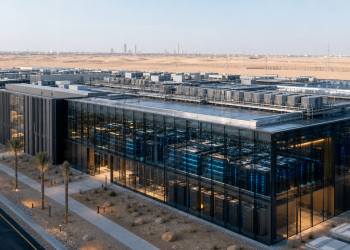
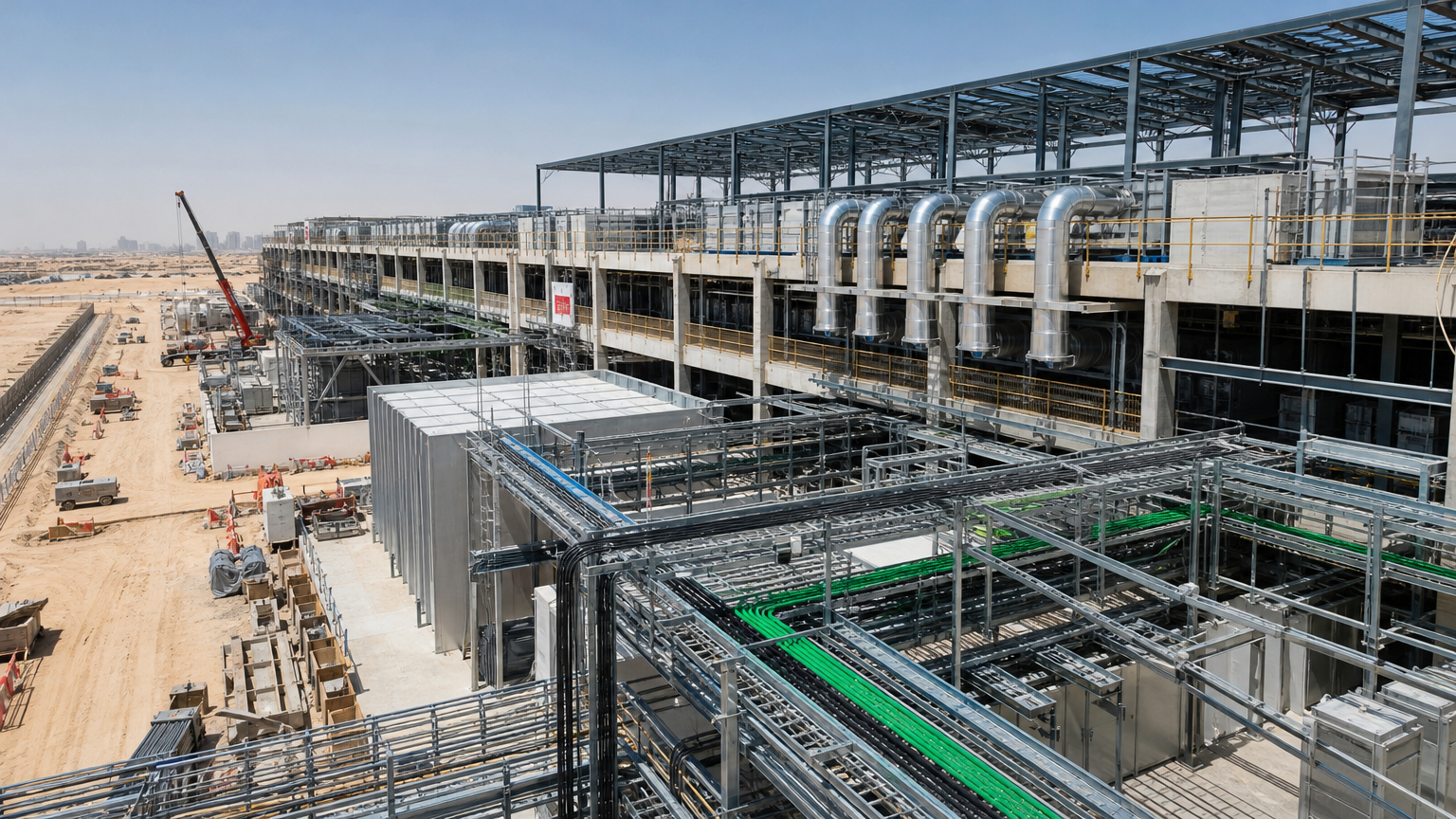
Saudi Arabia just handed out a $200m contract to build one of its biggest AI data centres yet, and it’s a sign of how fast the Gulf’s AI ambitions are moving. Egyptian contractor Hassan Allam Construction and India’s Sterling & Wilson have jointly won the SR750m deal to build the first phase of a new facility in Riyadh, one that’s designed from the ground up to train and run artificial intelligence models at massive scale.
What’s actually being built in Riyadh
The project is being developed by Humain, Saudi Arabia’s homegrown AI company, together with Center3, the digital infrastructure arm of telecom giant STC Group. The first phase will have an IT load capacity of 16.2MW. Once the second phase is finished, total capacity will climb to 50MW.
The contract covers everything from civil and architectural work to the mechanical, electrical and plumbing systems that keep a data centre running, plus all the surrounding infrastructure. When both phases are complete, the site will house one standard-density hall rated at 5MW and four high-density halls, each capable of handling 11.2MW. Construction on phase one is expected to take 16 months.
This isn’t a one-off project either. Humain and Center3 first teamed up back in December to build AI-focused data centres across the Kingdom, with a combined target capacity of up to 1GW. The partners have said this particular site alone could eventually deliver up to 250MW of capacity, specifically engineered for high-density AI workloads and the kind of large-scale model training that powers today’s most advanced AI systems.
Why this matters beyond Saudi Arabia
If you’re following innovation news out of the Gulf, this deal is worth paying attention to. It’s not just about concrete and cabling. It’s about who controls the physical backbone that AI runs on. Center3 brings existing data centre operations and regional connectivity to the table. Humain is handling something more specialised: making sure the facility’s design actually matches what cutting-edge AI compute needs, both now and as the technology evolves.
That combination matters because AI infrastructure isn’t like a typical office building or warehouse. These facilities need to handle enormous power density without overheating, keep latency low so data moves fast, and stay resilient enough to run large language models and other mission-critical applications around the clock. The companies behind the project say that’s exactly what they’re building: purpose-built facilities engineered for those specific demands.
For businesses and investors across the UAE and wider GCC, this is part of a bigger regional story. Governments across the Gulf have been racing to build out the data centre capacity needed to host AI models locally, rather than relying entirely on infrastructure based overseas. Having that capacity close to home can mean faster processing, tighter data control, and more opportunities for local firms to plug into the AI economy as customers, suppliers or partners.
It also puts Saudi Arabia in direct competition with the UAE, which has been pushing its own AI and data centre ambitions hard in recent years. Whoever builds out capacity fastest and most reliably stands to attract more AI companies, cloud providers and enterprise customers looking for a regional base. A 1GW target from Humain and Center3 alone shows just how seriously Saudi Arabia is taking this race.
The involvement of international contractors is notable too. Hassan Allam Construction, based in Egypt, and Sterling & Wilson, based in India, winning this contract shows Gulf AI infrastructure projects are drawing in major regional and international players, not just local firms. That’s likely to continue as more data centre projects get announced across Saudi Arabia and the UAE over the coming years.
What to watch next: whether phase one finishes on schedule within its 16-month window, and how quickly Humain and Center3 move toward that larger 1GW target across the Kingdom. This report was first covered by MEED, and more details on contract awards and expansion timelines are likely to surface as construction progresses.