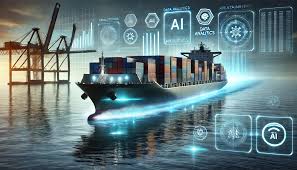
More than 80 percent of world trade moves by sea. Oil, food, electronics, automobiles, medicine, industrial equipment, and raw materials all travel through vast maritime networks connecting continents and economies. Every supermarket shelf, factory production line, and e-commerce delivery depends on ships moving efficiently across oceans.
Yet despite its immense importance, shipping remains one of the world’s most conservative industries. Many operational systems still rely on fragmented communication, manual paperwork, outdated logistics models, and human-dependent decision-making. Ports often suffer from congestion and inefficiency. Fuel consumption remains enormous. Supply chains remain vulnerable to geopolitical shocks, weather disruptions, piracy, labor shortages, and cyberattacks.
The COVID-19 pandemic exposed just how fragile global maritime logistics truly are. Port closures, container shortages, and supply chain breakdowns created worldwide economic disruption. Suddenly, the shipping industry—usually hidden from public attention—became central to global discussions about resilience, trade, and economic security.
Now, a new technological revolution is arriving at sea: Artificial Intelligence.
AI is rapidly transforming industries from finance and healthcare to defense and manufacturing. The shipping sector may become one of its most strategically important frontiers. Supporters argue AI could make maritime transport safer, cleaner, faster, and vastly more efficient. Critics warn it could disrupt labor markets, increase cyber vulnerabilities, and create dangerous dependencies on automated systems.
What is increasingly clear, however, is that AI is poised to reshape global shipping in ways that may fundamentally alter international trade itself.
At its core, shipping is a data-intensive industry.
Ships generate enormous amounts of operational information every day: fuel consumption, engine performance, weather conditions, cargo status, navigation routes, port schedules, and maintenance records. Historically, much of this data remained underutilized because human operators could not process it effectively in real time.
AI changes that equation.
Modern machine learning systems excel at analyzing complex patterns across massive datasets. In shipping, this capability could dramatically improve operational efficiency. AI-powered route optimization systems can already calculate the most fuel-efficient and time-effective paths by analyzing weather, ocean currents, port congestion, and fuel prices simultaneously.
The financial implications are enormous.
Fuel represents one of the largest costs in maritime transport. Even small efficiency improvements can save shipping companies millions of dollars annually while significantly reducing carbon emissions. As environmental regulations tighten and pressure grows to decarbonize global trade, AI-driven optimization may become essential rather than optional.
Predictive maintenance is another major area of transformation.
Traditionally, ships undergo scheduled maintenance based on fixed intervals or after breakdowns occur. This approach is costly and inefficient. Unexpected mechanical failures can delay cargo deliveries, disrupt supply chains, and create safety risks at sea.
AI-powered predictive maintenance systems can monitor engines, turbines, pumps, and other critical equipment continuously. By analyzing sensor data in real time, AI can identify early signs of wear or malfunction before serious failures occur. Instead of reacting to problems after damage happens, operators can intervene proactively.
This shift could reduce downtime dramatically while improving vessel reliability and safety.
Ports themselves are also becoming increasingly intelligent.
Some of the world’s largest ports are already integrating AI systems to manage traffic flow, cargo handling, and logistics coordination. Port congestion remains one of the greatest inefficiencies in global trade. Ships often wait offshore for days before unloading, wasting time, fuel, and money.
AI can help synchronize arrivals, optimize docking schedules, and coordinate container movement more efficiently. Automated cranes, AI-driven inventory systems, and predictive logistics platforms may transform ports into highly integrated digital ecosystems.
The result could be faster global trade flows and more resilient supply chains.
Container tracking is another area where AI is proving valuable.
Modern consumers increasingly expect transparency and speed in delivery systems. Companies want real-time visibility across supply chains. AI combined with Internet of Things sensors allows shipping firms to monitor cargo conditions continuously. Temperature-sensitive pharmaceuticals, food products, and high-value goods can be tracked and protected more effectively during transit.
This capability becomes particularly important for industries relying on precision logistics, such as healthcare and advanced manufacturing.
Safety at sea may also improve significantly through AI integration.
Maritime accidents often result from human error, fatigue, poor visibility, or communication failures. AI-assisted navigation systems can analyze radar, satellite data, weather conditions, and nearby vessel movements simultaneously, helping crews avoid collisions and hazardous situations.
Autonomous shipping is perhaps the most controversial frontier.
Several companies and governments are already testing partially autonomous or remotely operated vessels. Proponents argue autonomous ships could reduce operational costs, improve fuel efficiency, and minimize accidents caused by human error. Critics, however, raise concerns about cybersecurity, reliability, and the future of maritime employment.
The idea of unmanned cargo ships navigating global oceans still sounds futuristic, but the industry is moving steadily in that direction.
The implications for labor are profound.
The global shipping industry employs millions of people, including sailors, port workers, logistics operators, and support staff. Automation and AI could reduce demand for certain traditional maritime roles while increasing demand for highly skilled technical workers capable of managing digital systems.
This transition may create social tensions similar to those experienced in manufacturing industries affected by automation. Maritime nations dependent on seafaring employment may face difficult economic adjustments.
Cybersecurity is another major concern.
As ships, ports, and logistics systems become more connected, they also become more vulnerable to cyberattacks. Modern vessels increasingly function as floating digital infrastructures. A successful cyberattack targeting navigation systems, cargo management platforms, or port operations could disrupt trade on a massive scale.
The shipping industry has already witnessed ransomware attacks and cyber incidents affecting major logistics companies. AI can help strengthen cybersecurity defenses by detecting anomalies and responding to threats faster than human operators. Yet attackers themselves are also using AI to develop more sophisticated cyber strategies.
This creates an escalating technological arms race at sea.
Environmental sustainability may become one of AI’s most important contributions to shipping.
The maritime industry accounts for a significant share of global greenhouse gas emissions. International regulators are under increasing pressure to decarbonize shipping over the coming decades. AI can help optimize fuel use, improve energy efficiency, and support integration of cleaner propulsion systems.
Some experts believe AI may accelerate the transition toward greener shipping technologies, including alternative fuels such as hydrogen, ammonia, and advanced battery systems. Intelligent systems can help manage complex hybrid energy operations more effectively than traditional manual processes.
Climate change itself also increases the importance of AI in maritime operations.
Extreme weather events, changing sea routes, and unpredictable environmental conditions create growing operational risks for shipping companies. AI-driven forecasting systems can improve decision-making under increasingly volatile conditions.
But perhaps the most transformative impact of AI lies in supply chain intelligence.
Global trade networks have become extraordinarily complex and interconnected. A disruption in one port or shipping lane can trigger cascading economic consequences worldwide. AI systems capable of analyzing global logistics patterns in real time may help companies anticipate disruptions before they escalate into crises.
The pandemic demonstrated how vulnerable supply chains are to sudden shocks. Future AI systems may provide greater resilience by enabling more adaptive and predictive logistics strategies.
Yet despite its enormous potential, AI is not a magic solution.
The shipping industry faces structural challenges that technology alone cannot solve. Geopolitical tensions, trade wars, piracy, regulatory fragmentation, labor disputes, and infrastructure bottlenecks remain deeply political and economic problems.
There is also the danger of overdependence on automation.
Shipping has historically relied on human judgment developed through experience at sea. Captains and crews often make critical decisions under uncertain and rapidly changing conditions. Fully replacing human intuition with algorithms carries risks, particularly in emergency scenarios where unexpected variables emerge.
The human factor in maritime culture remains deeply important.
Moreover, smaller shipping companies and developing nations may struggle to adopt expensive AI systems at the same pace as large multinational operators. This could widen competitive inequalities within the global maritime industry.
The geopolitical implications are equally significant.
Countries controlling advanced maritime AI technologies may gain strategic advantages in trade, logistics, and naval operations. Shipping has always been linked to global power. From the British Empire to modern superpowers, maritime dominance shaped geopolitical influence. In the AI era, digital maritime superiority may become just as important as physical naval strength.
China, the United States, Europe, Singapore, and Gulf states are all investing heavily in smart ports, maritime AI systems, and digital logistics infrastructure. The race to dominate next-generation shipping technologies is quietly becoming part of the broader global technological competition.
Ultimately, AI represents both an opportunity and a challenge for the shipping industry.
It could create safer vessels, cleaner operations, smarter logistics, and more resilient supply chains. It may reduce waste, optimize energy consumption, and transform how goods move across the planet. In many respects, AI could modernize an industry that has historically evolved more slowly than other sectors.
But technological transformation also requires governance, ethics, workforce adaptation, and cybersecurity resilience.
The future shipping industry may look radically different from today’s world of paperwork, fragmented logistics, and manually coordinated operations. Ships may become increasingly autonomous. Ports may function as intelligent digital ecosystems. Global trade flows may become more predictive and interconnected than ever before.
The oceans will remain the arteries of global civilization.
But increasingly, Artificial Intelligence may become the invisible navigator guiding the future of world trade itself.