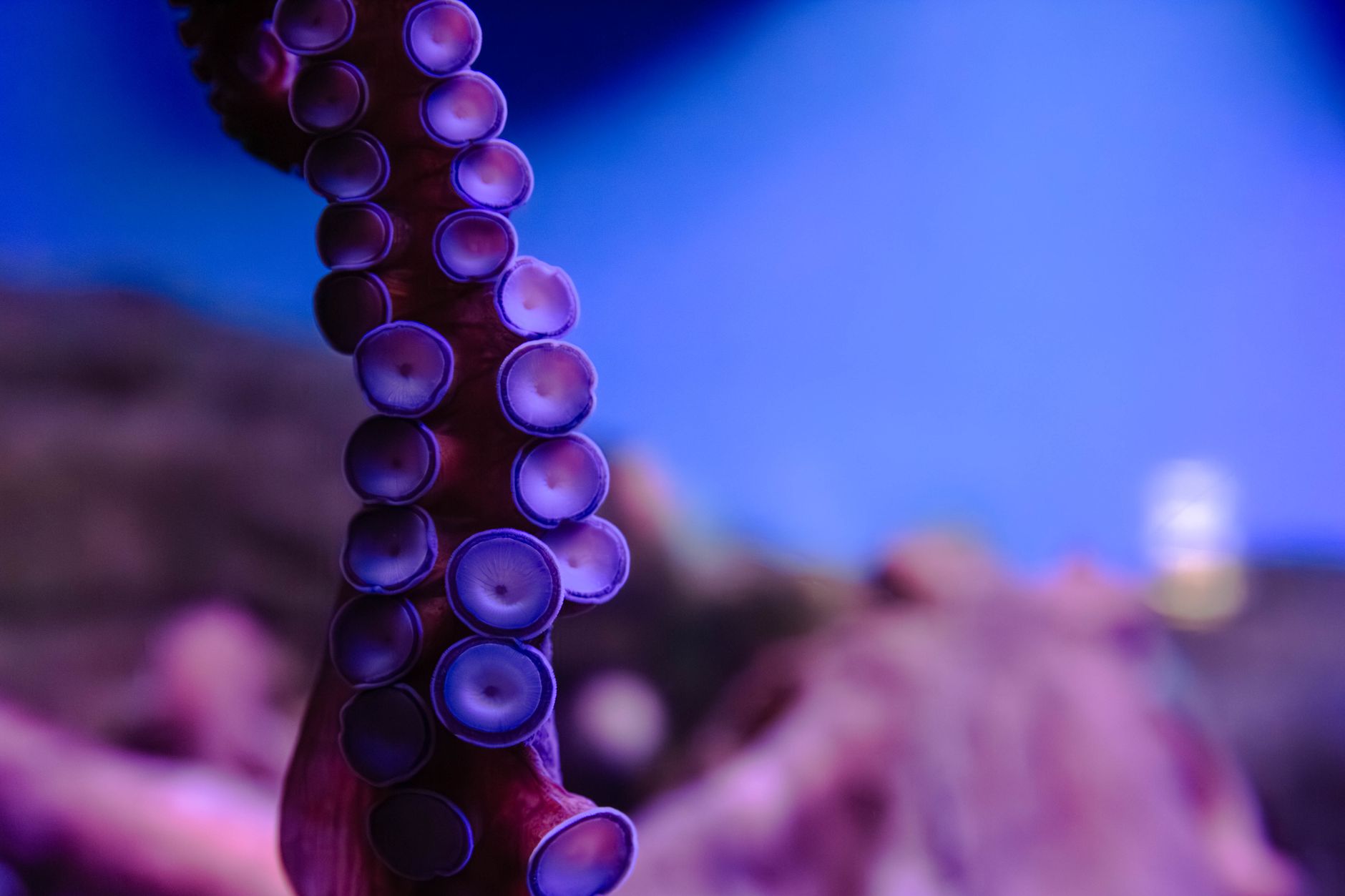
Scientists studying the octopus nervous system have found that the animal’s extraordinary problem-solving abilities stem not from a single, centralized brain but from a nervous system distributed across its entire body. Roughly two-thirds of an octopus’s estimated 500 million neurons are located not in its head but in its eight arms, giving each limb a striking degree of independence from central command.
This architecture sets octopuses apart from most animals, including humans, whose neural processing is concentrated almost entirely in the brain. In octopuses, each arm contains enough neural tissue to process sensory information and initiate movement on its own, effectively allowing the limb to “think” for itself in a limited but functional sense.
Researchers describe the arrangement as a form of distributed intelligence. Rather than the brain issuing detailed instructions for every motion, it can delegate specific tasks to individual arms, which then carry them out using their own local neural circuitry. The central brain retains a coordinating role, but much of the moment-to-moment decision-making happens far from it, in the arms themselves.
Arms That Act Alone
The practical effects of this setup are visible in how octopuses behave. An arm can search for food, probe crevices, grip prey, or react to a touch or threat without waiting for a signal from the brain. This means an octopus can effectively multitask at a physical level: one or more arms might be occupied with hunting while others simultaneously explore the surrounding environment or guard against predators.
The independence extends even to reproduction. Male octopuses have a specialized arm known as the hectocotylus, used to transfer sperm during mating, which operates under its own localized neural control. That such a critical biological function can proceed with a degree of autonomy from the central brain underscores how deeply distributed the octopus nervous system is.
Scientists suggest this decentralized design likely evolved as a survival advantage. Octopuses inhabit complex, often dangerous marine environments where speed and adaptability matter. By allowing arms to react and operate semi-independently rather than routing every decision through a central processor, the animal can respond more quickly to opportunities and threats, and manage several tasks in parallel rather than sequentially.
The findings also carry implications beyond marine biology. Researchers studying distributed decision-making systems see the octopus as a natural model for how complex behavior can emerge without a single point of control. Fields such as robotics and artificial intelligence have long grappled with the challenge of building systems that can operate efficiently without constant oversight from a central processor. The octopus’s arm-level autonomy offers a biological blueprint for such decentralized control, though experts caution that translating these insights into engineered systems remains largely theoretical at this stage.
The research is part of a broader effort to understand cephalopod cognition, an area of growing scientific interest given the octopus’s unusual combination of intelligence, flexibility and a nervous system that diverges sharply from the vertebrate model. While the study itself has no direct connection to the Gulf region, octopuses are found in regional waters and are part of commercial and recreational fishing activity along parts of the Arabian Peninsula coastline, making the broader science of cephalopod biology of incidental relevance to those following regional marine life and fisheries.
No timeline has been given for when, or whether, insights from octopus neurology might translate into practical applications in robotics or computing.