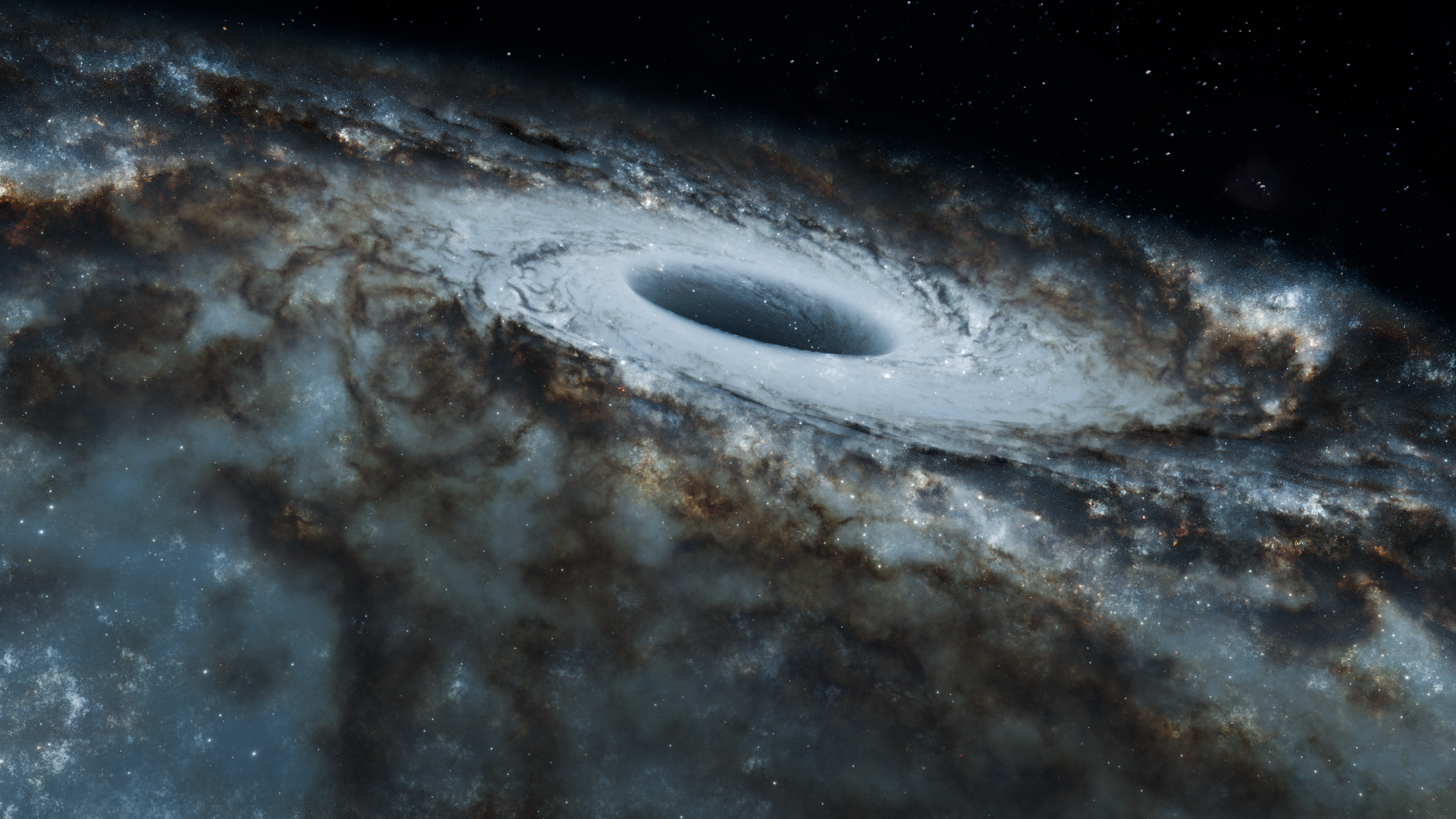
A star hurtling around the supermassive black hole at the centre of the Milky Way has emerged as one of the most valuable tools available to astronomers seeking to understand how gravity behaves under the most extreme conditions in the universe. The star, designated S301, follows an orbit so tight and so fast around Sagittarius A* that scientists say its trajectory can be used to measure the way the black hole’s rotation warps the fabric of space and time around it.
Sagittarius A* sits roughly 26,000 light-years from Earth and is estimated to contain millions of times the mass of the Sun, making it the dominant gravitational force at the galaxy’s core. While black holes themselves cannot be observed directly, their influence on nearby matter offers indirect evidence of their properties. S301’s unusually close and rapid orbit places it in a gravitational environment extreme enough to reveal effects predicted by physics but rarely, if ever, measurable elsewhere.
Researchers tracking the star’s path say its motion is being distorted in ways consistent with a rotating massive object dragging spacetime along with it, an effect long theorised but difficult to confirm observationally. By carefully charting how S301’s orbit deviates from what would be expected around a simple, non-rotating mass, scientists can begin to extract details about Sagittarius A* itself, including estimates of its spin and how its mass is distributed.
A Natural Laboratory for Testing Einstein
The discovery is being framed by researchers as a natural laboratory for testing predictions made by Albert Einstein’s general theory of relativity, which describes gravity not as a force in the traditional sense but as a curvature of space and time caused by mass. Around ordinary stars and planets, these effects are exceedingly small and difficult to detect. Around a supermassive black hole, however, the distortions become pronounced enough to measure, provided a suitable test object exists close enough to the source.
S301 fits that role because of its proximity to Sagittarius A* and the sheer speed at which it travels, reportedly making it the fastest known star in the galaxy. That combination allows astronomers to observe relativistic effects with a level of precision that would be impossible using more distant or slower-moving stars, several of which have already been used in past decades to help confirm the presence and rough mass of the black hole itself.
The ability to make these measurements reflects broader advances in observational astronomy, including improvements in telescope sensitivity and in the computational methods used to process faint, rapidly changing signals from the galactic centre. Tracking a star’s position and velocity with the accuracy required to detect spacetime warping demands both high-resolution imaging and long-term monitoring, capabilities that have matured significantly in recent years.
Scientists say the findings extend beyond confirming decades-old theoretical predictions. Understanding the spin and mass characteristics of Sagittarius A* feeds into wider research on how supermassive black holes form, grow and interact with surrounding galaxies, a question central to modern astrophysics and cosmology.
While the research has no direct operational link to the UAE or the wider Gulf region, it holds relevance for the region’s growing space science community. The UAE has expanded its investment in astronomy and space exploration in recent years, including missions and research partnerships focused on planetary science and astrophysics. Advances in techniques used to study distant, extreme gravitational environments such as Sagittarius A* contribute to the broader scientific knowledge base that regional space agencies and research institutions draw upon as they build out their own observational and research capabilities.