Why the Future of Smart Buildings Depends on Technology Convergence
For years, the smart-building conversation has often been framed around individual technologies: a more capable video surveillance platform, faster Wi-Fi, intelligent access control, automated lighting, advanced guest-room controls or a new building-management platform. Each improvement can create value, but the next phase of smart infrastructure will be defined less by the intelligence of individual products and more by how effectively they work together.
This is particularly relevant in the UAE, where digital infrastructure, sustainability and connected services are increasingly being developed as parts of the same wider ecosystem. The UAE’s digital-government strategy identifies world-class digital infrastructure, common digital enablers, integrated services and stronger digital capabilities as national priorities. Dubai’s own infrastructure programmes similarly demonstrate a shift toward interconnected, data-driven systems.
For the built environment, this creates a clear challenge: a building cannot become truly smart simply by accumulating smart devices. It becomes smart when its technology architecture allows systems, data and people to operate as one environment.
The Smart Building Is Becoming a Technology Ecosystem
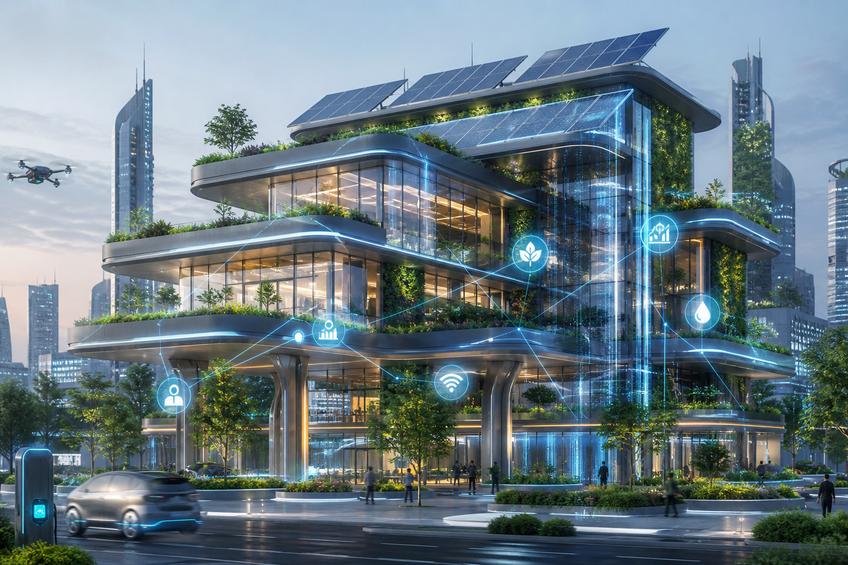
A modern development can contain dozens of technology platforms. ICT networks connect users and devices. Security systems protect people and assets. Audio visual platforms support communication and experience. Guest Room Management Systems and lighting control influence comfort and energy use. Building automation monitors and controls operational functions. EV chargers add another connected layer at the intersection of mobility, energy and digital services.
Historically, many of these systems were designed as separate packages. That approach becomes increasingly difficult as devices move onto IP networks and applications begin to exchange data.
The shift is already visible in major UAE infrastructure. Dubai Electricity and Water Authority’s Smart Grid strategy is built around an interconnected network using technologies including AI and IoT, with interoperability and automated decision-making as explicit capabilities. DEWA says the programme carries AED 7 billion in investment through its smart-grid strategy.
The lesson for buildings is not that every development needs the same technology. It is that integration must be considered as architecture rather than as an afterthought.
1. The Network Is No Longer Just an ICT Package
As more systems become IP-based, the network increasingly acts as the common digital foundation of the building.
Cameras, access-control panels, intercoms, AV endpoints, controllers, sensors and management platforms may all depend on network availability. This makes decisions about topology, bandwidth, VLANs, redundancy, cybersecurity, power resilience and wireless coverage relevant far beyond the IT department.
The UAE’s Telecommunications and Digital Government Regulatory Authority highlights this convergence in its telecommunications infrastructure guidance. Its Smart Buildings Guideline, developed with Dubai Municipality and industry stakeholders, covers telecommunications integration, IoT and cybersecurity.
For project teams, this means ICT design should be coordinated with the operational requirements of connected systems from the beginning. Designing the network first and asking application teams to “fit into it” later can be as problematic as designing every application independently and discovering at commissioning that the infrastructure cannot support the combined requirement.
2. Integration Must Start Before Procurement
Technology convergence changes the sequence of decision-making.
Before equipment is ordered, teams should understand which systems must communicate, what data will be exchanged, which protocols or APIs are required, where the system boundaries sit and who is responsible for each interface.
An interface matrix is a simple but powerful tool. It can identify, for example, whether an access-control event should trigger a video-management action, whether room occupancy should influence lighting and climate settings, or whether an EV-charging platform needs connectivity to wider energy-management or user-authentication systems.
The purpose is not to integrate everything simply because it is technically possible. Good integration starts with an operational objective. Every interface should answer a practical question: what outcome becomes safer, faster, more efficient or easier to manage because these systems communicate?
3. Data Is Valuable Only When It Improves Decisions
Connected buildings can generate enormous quantities of information, but more data does not automatically create a smarter operation.
The value comes from converting data into decisions and actions.
Dubai provides a useful large-scale example. DEWA’s Distribution Network Smart Centre monitors smart infrastructure and analyses data, alarms and readings from connected assets. DEWA reported that the centre analyses more than 15 million data points daily and uses technologies including AI and machine learning to support diagnostics, proactive maintenance and decision-making.
At building level, the same principle applies on a different scale. Operators do not necessarily need another dashboard. They need useful information: abnormal equipment behaviour, recurring alarms, occupancy patterns, energy anomalies, security events or maintenance indicators that can lead to a clear response.
The future smart building should therefore be designed around actionable information, not dashboard quantity.
4. Cybersecurity Becomes a Building Issue
Convergence also changes risk.
When operational systems were isolated, a problem in one system could remain relatively contained. As more devices share networks and exchange information, cybersecurity becomes part of building engineering.
This does not mean every project team must become a cybersecurity specialist. It means cybersecurity requirements should be established alongside functional requirements. Network segmentation, access privileges, credential management, software updates, remote access, device hardening, logging and backup strategies all need ownership.
The more connected the building becomes, the more important it is to know not only what systems can communicate, but what systems should be allowed to communicate.
5. Design for the Building’s Next Ten Years, Not Only Opening Day
One of the biggest risks in technology projects is optimising everything around handover.
Buildings may operate for decades, while digital technologies evolve much faster. Devices will be replaced, software will be upgraded, user expectations will change and new applications will emerge.
This makes interoperability, scalability and maintainability strategic considerations.
A future-ready building should have room for network expansion, documented interfaces, accessible configuration records and an architecture that does not make every upgrade dependent on replacing the entire ecosystem.
The question during design should not only be, “Does this solution meet today’s specification?” It should also be, “How difficult will it be to adapt this environment five years from now?”
6. The Human Layer Still Determines Success
Technology convergence may sound like a product or software challenge, but it is equally an organisational challenge.
ICT engineers need a working understanding of security and operational technology. Security teams increasingly need networking knowledge. Project managers must coordinate interfaces across disciplines. Procurement teams need to recognise when substitutions affect compatibility. Commissioning teams must test end-to-end outcomes rather than only individual equipment.
This makes cross-functional learning increasingly important.
The strongest technology organisations will not necessarily be those with the longest list of vendor partnerships. They will be those that can bring engineering, commercial, project and service teams together around a common understanding of how the complete environment should operate.
The UAE Is Already Showing What Convergence Can Look Like
Recent UAE projects illustrate how far the concept can go. In 2026, Dubai inaugurated DEWA’s Al Shera’a headquarters as a net-positive government building with an integrated cognitive system. According to the Government of Dubai Media Office, the building uses more than 110,000 smart sensors, over 1,500 wireless access points and more than 3,200 network devices, generating more than 1.9 million automated control commands each day.
Dubai Municipality has also adopted an integrated facilities-management model covering around 2,000 buildings and public facilities and more than 246,000 assets. The municipality reported an operational-efficiency improvement of more than 15% compared with the previous decentralised model, supported by technologies including IoT, predictive maintenance and real-time digital dashboards.
These examples operate at a scale far beyond a typical commercial development, but they reinforce the same principle: integration creates value when connectivity, data and operational processes are designed together.
From Smart Products to Smart Outcomes
The next stage of smart-building development should move the conversation away from individual product intelligence and toward whole-system outcomes.
A building may contain excellent technology and still be difficult to operate if systems are fragmented, responsibilities are unclear or data cannot be translated into action. Conversely, a carefully engineered environment can create significant value without unnecessary complexity.
For developers, consultants, integrators and technology leaders, the priorities are becoming clearer: establish the digital backbone, define integration early, design cybersecurity into the architecture, focus on actionable data, plan for lifecycle change and develop teams that understand more than one technology domain.
The future smart building will not be the one with the greatest number of connected devices.
It will be the one in which technology works together so naturally that users rarely need to think about the complexity behind it.
That is the real promise of technology convergence.