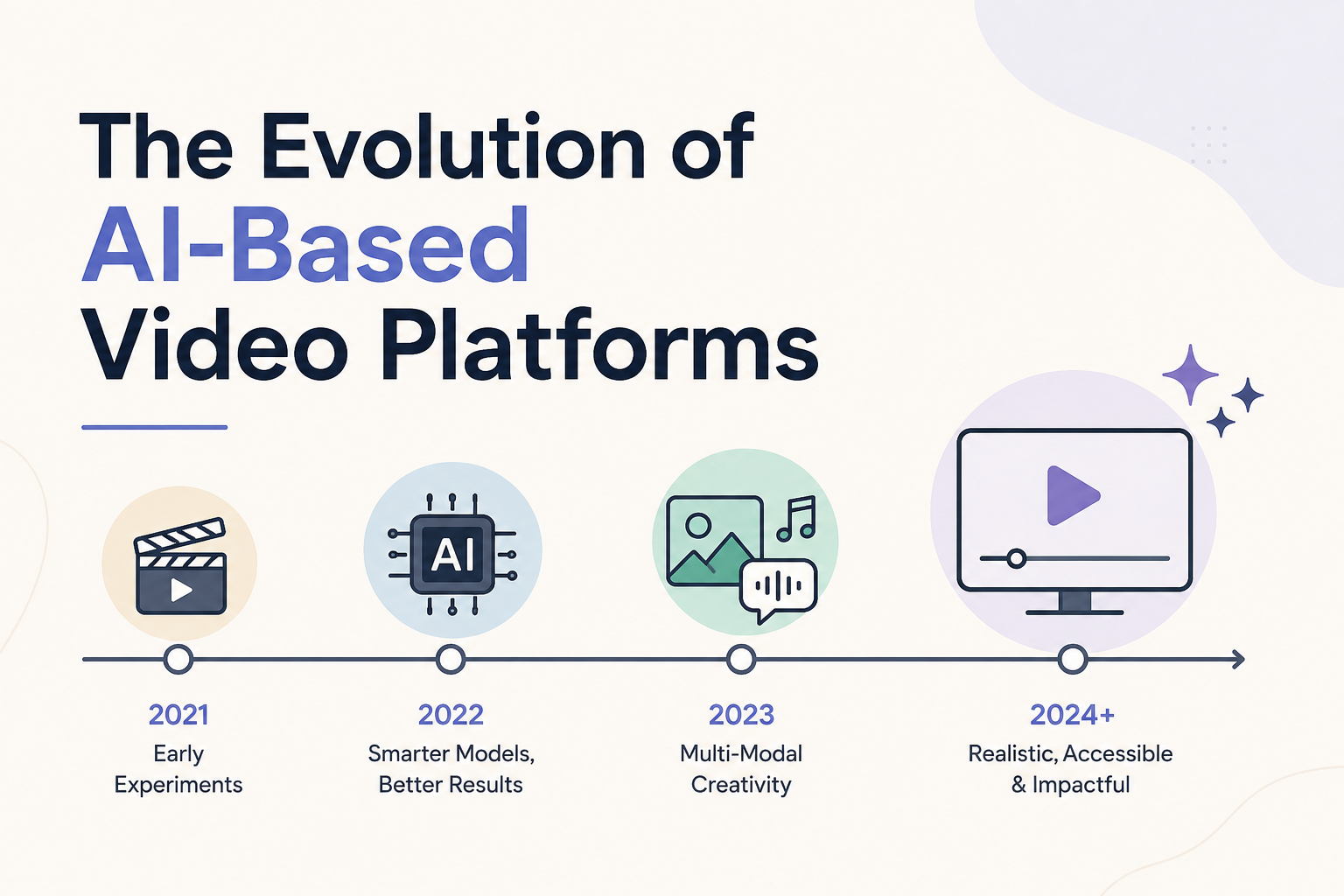
Three years ago, the idea of creating a polished video simply by describing it in a sentence seemed more like science fiction than a practical production method. Today, AI-generated video has become one of the fastest-moving areas in artificial intelligence, reshaping how creators, businesses, educators and media organizations approach visual storytelling.
The transformation did not happen overnight. Instead, it unfolded through a series of technological leaps that steadily reduced the barriers between imagination and production.
In the early stages, AI video tools focused primarily on generating short clips with limited movement. Faces often appeared distorted, objects shifted unexpectedly between frames, and maintaining consistency throughout a sequence remained a significant challenge. While the technology attracted widespread curiosity, it was largely viewed as an experimental novelty rather than a reliable creative tool.
The landscape began to change as advances in machine learning dramatically improved the ability of AI systems to understand language, motion and visual relationships simultaneously. Instead of interpreting prompts as isolated commands, newer models started recognizing context, enabling them to generate scenes with greater coherence and continuity.
This evolution coincided with rapid improvements in computing infrastructure.
Faster processors, specialized AI chips and more efficient training methods allowed increasingly sophisticated models to become accessible to businesses and individual creators alike. What once required extensive computational resources gradually became available through cloud-based platforms, enabling anyone with an internet connection to experiment with AI-powered filmmaking.
Another defining shift was the emergence of multimodal artificial intelligence. Rather than relying solely on text prompts, platforms began integrating images, voice recordings, sketches and reference videos into the creative process. Users could describe a scene, upload visual inspiration and receive videos that reflected both their written instructions and artistic references.
For filmmakers and creative professionals, this marked a turning point. AI was no longer simply generating isolated clips; it was becoming a collaborative production assistant capable of accelerating storyboarding, concept visualization and early-stage production.
Businesses quickly recognized the commercial potential. Marketing teams started producing promotional videos in hours instead of weeks. Educational organizations created personalized learning content at unprecedented speed, while product demonstrations, social media campaigns and internal corporate communications increasingly relied on AI-assisted video generation.
The creator economy also experienced significant changes.
Independent content producers gained access to capabilities that were previously reserved for studios with substantial production budgets. Small businesses found themselves able to compete visually with much larger organizations, producing high-quality branded content without investing heavily in cameras, crews or editing facilities.
Yet technological progress brought equally important conversations about ethics and authenticity.
As video generation became increasingly realistic, concerns surrounding misinformation, copyright, digital identity and synthetic media intensified. Industry leaders responded by introducing watermarking initiatives, transparency standards and content verification systems designed to distinguish AI-generated media from traditional recordings.
Governments and regulatory bodies also began examining how synthetic media should be governed without restricting innovation. While approaches continue to vary across regions, discussions increasingly focus on accountability, disclosure and responsible deployment rather than limiting the technology itself.
Perhaps the most notable development over the past three years has been the growing emphasis on quality rather than novelty.
Early demonstrations often showcased what AI could generate. Today’s platforms increasingly emphasize how creators can control the output. Users now expect consistent characters, accurate camera movements, cinematic lighting, synchronized dialogue and editable timelines. The industry has shifted from simply asking whether AI can generate video to determining how effectively creators can direct it.
This transition reflects a broader maturation of the technology. AI is increasingly positioned not as a replacement for human creativity, but as a production partner capable of handling repetitive tasks while allowing creators to focus on storytelling, strategy and artistic direction.
Looking ahead, the next phase appears likely to center on greater interactivity.
Rather than producing static videos, future systems are expected to generate experiences that adapt to viewer preferences, allowing audiences to influence narratives, languages or visual styles in real time. Personalized educational content, dynamic advertising campaigns and immersive entertainment could become increasingly commonplace as AI models continue to improve.
Integration across creative workflows is also expected to deepen. Video generation will likely connect seamlessly with scriptwriting, voice synthesis, animation, music composition and post-production editing, enabling end-to-end creative pipelines powered by increasingly intelligent assistants.
For newsrooms and media organizations, AI video may also reshape how visual journalism is produced. While editorial oversight will remain essential, AI has the potential to accelerate explainer videos, data visualizations and multilingual reporting, helping publishers deliver richer content more efficiently.
The rapid evolution of AI video platforms over the past three years illustrates how quickly emerging technologies can transition from experimental demonstrations to practical creative tools. Although technical, ethical and regulatory challenges remain, the trajectory is becoming increasingly clear.
The future of AI-generated video will not simply be measured by how realistic the visuals become. Its true impact will likely be defined by how effectively technology expands human creativity, democratizes production and enables storytellers of every scale to bring their ideas to life.