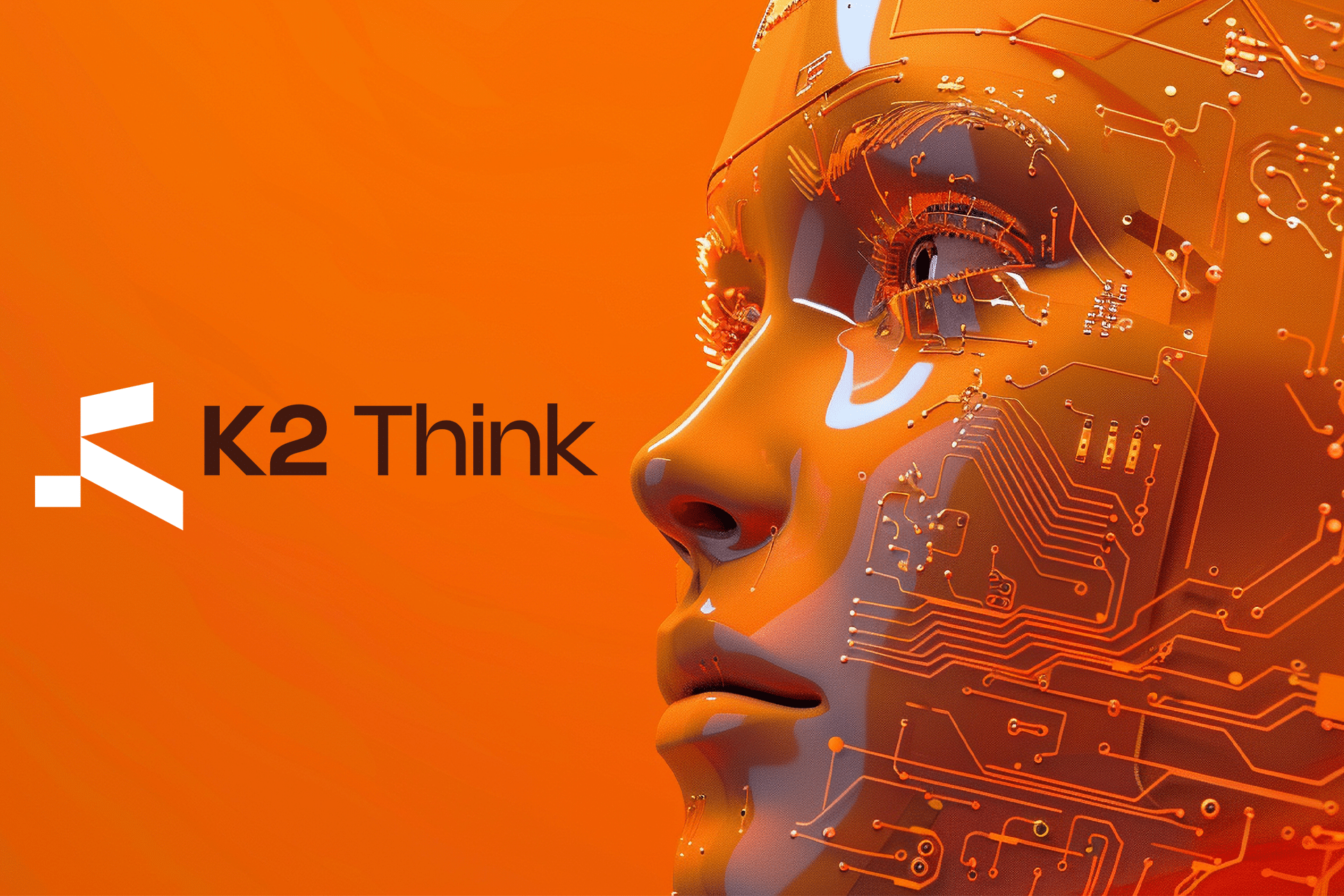
The United Arab Emirates is stepping up its artificial intelligence AI game — not just by building big data centers, but by innovating in “smaller but smarter” models. In recent weeks, the country’s researchers unveiled K2 Think, a 32-billion-parameter AI model built for reasoning and efficient planning. This development signals a major milestone in the UAE’s ambition to become a global AI hub.
What Is K2 Think?
K2 Think was developed by Mohamed bin Zayed University of Artificial Intelligence (MBZUAI) in cooperation with the tech giant G42. Despite being relatively modest in size (32B), the model competes with very large language models thanks to innovations like “agentic planning” and reinforcement learning. In simple terms, K2 Think can think ahead: it reasons, plans steps, and adapts — not just respond to a prompt.
Why It Matters for the UAE
- Sovereign Tech Capability: By building its own powerful reasoning model, the UAE reduces reliance on foreign AI providers.
- Efficiency: Smaller models like K2 Think are cheaper to run, especially important when scaling AI across government, business, and research.
- National Strategy Alignment: This aligns with the UAE’s broader AI-national vision, including building sovereign computing infrastructure.
- Research Leadership: It positions MBZUAI and G42 as global players not just in “bigger models,” but in smarter, more optimized AI.
Infrastructure Behind the Innovation
This work is backed by serious compute: the UAE is building a massive AI-campus (“Stargate UAE”) via G42, expected to deliver 5 GW of data-center capacity.
Moreover, Microsoft has committed to shipping a significant number of Nvidia’s advanced AI chips (GB300 Grace Blackwell) to UAE data centers, under licenses approved by U.S. regulators.
Together, these initiatives create a strong foundation for running high-performance AI models like K2 Think within the UAE.
Governance & Trust: Building the Responsible AI Path
The UAE is not just building capacity — it’s also building governance maturity. According to a recent survey, the country’s AI and data infrastructure are being rated very favorably in terms of governance and ethical readiness.
This governance foundation is critical: as powerful AI systems grow, questions about misuse, bias, and privacy increase. The UAE’s strategy is to be proactive — not reactive.
Public Adoption & Use
AI use in the UAE is surging. A recent report revealed that nearly nine in ten people in the UAE have used AI for work, study, or personal tasks — significantly above the global average. \
This adoption is not just limited to businesses: individuals are incorporating AI into daily life, making the technology a real part of the national fabric.
Looking Ahead: Applications & Impact
- Government Services: K2 Think and similar models could be used to automate and optimize policymaking, public service delivery, and planning.
- Enterprise Use: Local businesses can use these models for forecasting, decision support, and optimization.
- Research & Education: MBZUAI could use K2 Think as a foundation for training the next generation of AI specialists.
- International Collaboration: The UAE can export its model or collaborate globally, offering a more efficient alternative to giant foundation models.
Challenges to Consider
- Computation Cost: Even “small” reasoning models need powerful infrastructure — ongoing investments will be required.
- Talent: Building, fine-tuning, and maintaining these models requires top-tier talent, which remains competitive globally.
- Ethical Deployment: Ensuring responsible use — especially in public systems — will require strong oversight and continuous refinement.
- Data: High-quality, relevant datasets will be needed to truly leverage the potential of such models in local contexts.
The launch of K2 Think is a bold statement: the UAE is not just buying or licensing AI, it is architecting its own intelligent future. By marrying efficient model design with massive infrastructure and strong governance, the country is setting itself up as a serious player in the next wave of AI. This model may be “smaller,” but it could power “smarter” solutions — and that might just be the recipe for lasting innovation.