By 2026, artificial intelligence has moved from boardroom buzzword to operational backbone. From logistics and finance to healthcare and media, algorithms increasingly shape decisions once reserved for human judgment. The rise of tools such as OpenAI’s ChatGPT and Google’s Gemini has transformed not only how companies process information, but how workers define their value.
The debate now dominating global economies is stark: Will AI cause widespread job loss, or will those who fail to use AI be the ones left unemployed?
The answer, as history suggests, is more complex than either extreme.
The Automation Shock
Artificial intelligence represents a new phase in automation. Previous technological revolutions replaced manual labor. AI, by contrast, reaches into cognitive territory: drafting contracts, analyzing medical scans, writing code, forecasting market movements.
Entire categories of routine white-collar work are now partially automated. Entry-level analysts, junior content creators, basic customer support agents, and even paralegals face an unprecedented shift. Tasks that once justified full-time positions can now be performed in seconds by machine-learning systems trained on vast datasets.
Corporations have responded predictably. Under pressure to increase efficiency and reduce operational costs, executives are integrating AI into workflows at remarkable speed. A single AI-enhanced employee can now perform the workload previously distributed among several workers. In accounting, legal services, and media production, productivity gains are measurable and dramatic.
Critics argue this creates structural unemployment. They warn that AI differs from earlier industrial disruptions because it targets both blue- and white-collar professions simultaneously. Unlike the mechanization wave of the early 20th century or the rise of the internet in the late 1990s, AI challenges knowledge-based roles once considered immune to automation.
For the first time, the middle class feels directly exposed.
Lessons from Previous Technological Revolutions
Yet history resists fatalism. The Industrial Revolution eliminated certain occupations but gave birth to entirely new industries. The arrival of computers in the 1980s sparked fear of mass clerical unemployment. Instead, digital economies produced software engineers, cybersecurity specialists, digital marketers, and countless roles unimaginable decades earlier.
AI is following a similar pattern.
Rather than eliminating work altogether, it is redefining work. Data scientists, AI ethicists, prompt engineers, AI compliance officers, and machine-learning auditors are now essential roles in corporate ecosystems. Companies require professionals capable not merely of operating AI tools but of guiding their responsible deployment.
The World Economic Forum estimates that while automation will displace millions of jobs, it will also create new positions requiring advanced skills, digital literacy, and human oversight.
The labor market is not shrinking; it is transforming.
The Real Divide: AI Users vs. AI Avoiders
What distinguishes this moment from previous technological waves is the speed of adoption and the accessibility of tools. Unlike expensive industrial machinery, AI systems are often cloud-based, scalable, and integrated into everyday applications. Many workers already carry AI-powered tools in their smartphones and laptops.
The critical risk today may not be automation itself, but resistance to adaptation.
In sectors ranging from marketing to financial services, professionals who leverage AI are outperforming peers who rely solely on traditional methods. An architect using generative design software completes projects faster. A financial analyst employing AI-driven forecasting tools detects patterns invisible to manual models. A doctor integrating AI diagnostics may identify early-stage diseases more accurately.
This is not merely about productivity — it is about competitiveness.
Workers who refuse or fail to integrate AI into their workflow risk obsolescence. Employers increasingly expect digital fluency as a baseline requirement. In recruitment processes, familiarity with AI platforms is becoming as essential as knowledge of office software once was.
The divide is emerging not strictly between humans and machines, but between augmented and non-augmented workers.
Productivity and the Corporate Imperative
From a corporate perspective, the logic of AI is compelling. Global markets are volatile. Geopolitical tensions, supply chain disruptions, and economic uncertainties demand agility. AI offers predictive analytics, operational efficiency, and scalable problem-solving at unprecedented speed.
Consider logistics firms that employ AI to reroute shipments in real time. Retail companies analyze consumer patterns with algorithmic precision. Financial institutions deploy automated fraud detection mechanisms. In manufacturing, predictive maintenance powered by AI reduces downtime and increases reliability.
The result is a competitive arms race. Companies that hesitate fall behind those embracing intelligent systems. Investors reward efficiency and scalability; boards demand digital transformation strategies.
The corporate imperative therefore reinforces technological momentum.
The Human Advantage
Yet AI’s strengths expose its limitations.
Artificial intelligence excels at pattern recognition, data processing, and optimization within defined parameters. It struggles with ambiguity, ethical judgment, deep interpersonal communication, and cultural nuance. Leadership, negotiation, empathy, and strategic foresight remain fundamentally human domains.
In fact, as automation expands, uniquely human skills become more valuable. Creativity, emotional intelligence, cross-disciplinary thinking, and complex problem-solving cannot be easily replicated by algorithms trained on historical data.
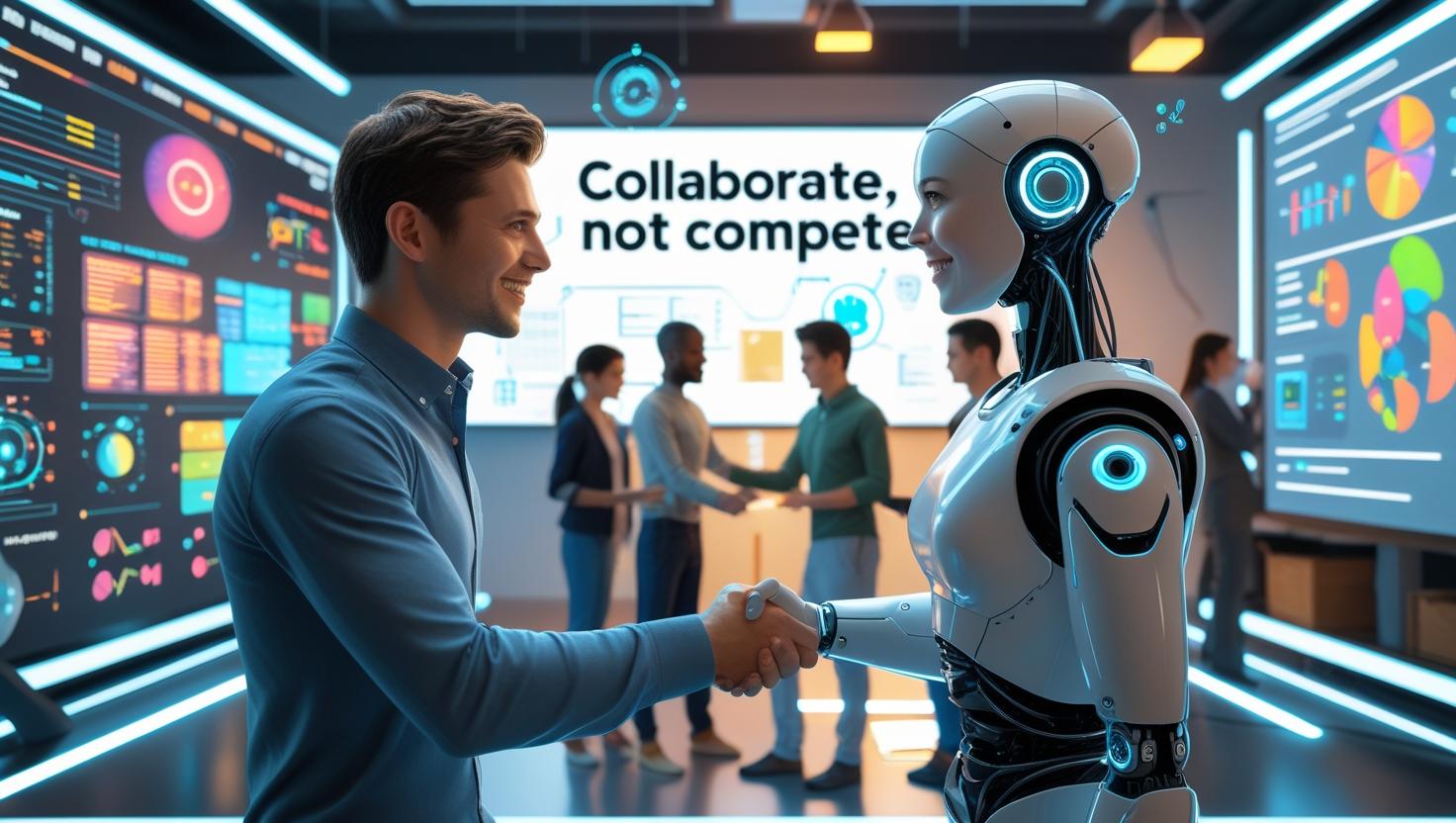
Executives increasingly speak not of replacing humans, but of “human-AI collaboration.” Doctors use AI to assist diagnoses but retain final authority. Lawyers draft with AI assistance but exercise judgment. Designers iterate concepts using generative tools while infusing projects with originality.
The emerging model is not substitution, but augmentation.
Education and the Skills Gap
The decisive battleground lies in education and reskilling.
If AI reshapes labor demand faster than educational institutions adapt curricula, structural unemployment becomes a real threat. Universities and vocational training centers must evolve rapidly, integrating data literacy, AI ethics, and digital systems management into core programs.
Governments also face policy challenges. Workforce transition programs, social safety nets, and incentives for upskilling are essential to cushion disruptions. Countries that invest aggressively in digital education will likely outperform those that cling to legacy models.
Emerging economies may even leapfrog advanced nations if they integrate AI-driven productivity tools early, avoiding costly industrial infrastructure phases.
Inequality: The Hidden Risk
While macroeconomic productivity may rise, AI could exacerbate inequality.
Highly skilled professionals capable of commanding and supervising intelligent systems may see income growth. Those in routine, repetitive roles could experience wage compression. Wealth may concentrate among technology developers and data owners.
If left unmanaged, this dynamic risks social tension. Policymakers are already debating taxation of automation, universal basic income proposals, and regulatory frameworks governing AI deployment.
Economic growth without inclusive distribution may prove politically destabilizing.
A Cultural Shift in Work
Beyond economics, AI challenges the philosophical meaning of work itself. For generations, employment has defined identity, stability, and social participation. If machines handle increasing portions of cognitive labor, societies must reconsider how individuals derive purpose and value.
Some optimists envision a post-work future where automation liberates people for creative, intellectual, and civic pursuits. Skeptics counter that economic systems are not yet structured to support such a transition.
What is certain is that AI accelerates a cultural transformation. Work becomes less about performing routine tasks and more about directing intelligent systems toward strategic objectives.
The Strategic Choice
So, will AI cause job losses, or will failure to use AI cost people their jobs?
Evidence suggests both dynamics are unfolding simultaneously. Certain roles will inevitably disappear or shrink. But more significantly, roles are evolving. The competitive disadvantage increasingly lies with those who ignore or resist technological integration.
The decisive question is not whether AI will shape the future of employment — it already has. The strategic question for individuals, corporations, and governments is whether they will shape AI in return.
Workers who invest in digital competence, critical thinking, and adaptive learning are likely to thrive. Companies that integrate AI responsibly while prioritizing human talent development will maintain resilience. Governments that anticipate labor shifts and invest in training will secure economic stability.
Conclusion: Adaptation Over Fear
Artificial intelligence represents neither inevitable mass unemployment nor automatic prosperity. It is a powerful tool — one that magnifies both strengths and weaknesses within economic systems.
History favors adaptation over resistance. Societies that embraced electricity, computing, and the internet ultimately expanded opportunity. Those that resisted stagnated.
The future of work will not be defined solely by machines replacing humans. It will be defined by humans who learn to work intelligently alongside machines. In that sense, the most significant risk may not be AI itself, but hesitation in mastering it.
The labor market of the next decade will reward flexibility, digital fluency, and strategic thinking. Those who view AI as a partner rather than a threat may find their roles not diminished, but elevated.
In the end, artificial intelligence will not decide who remains employed.
Human adaptation will.