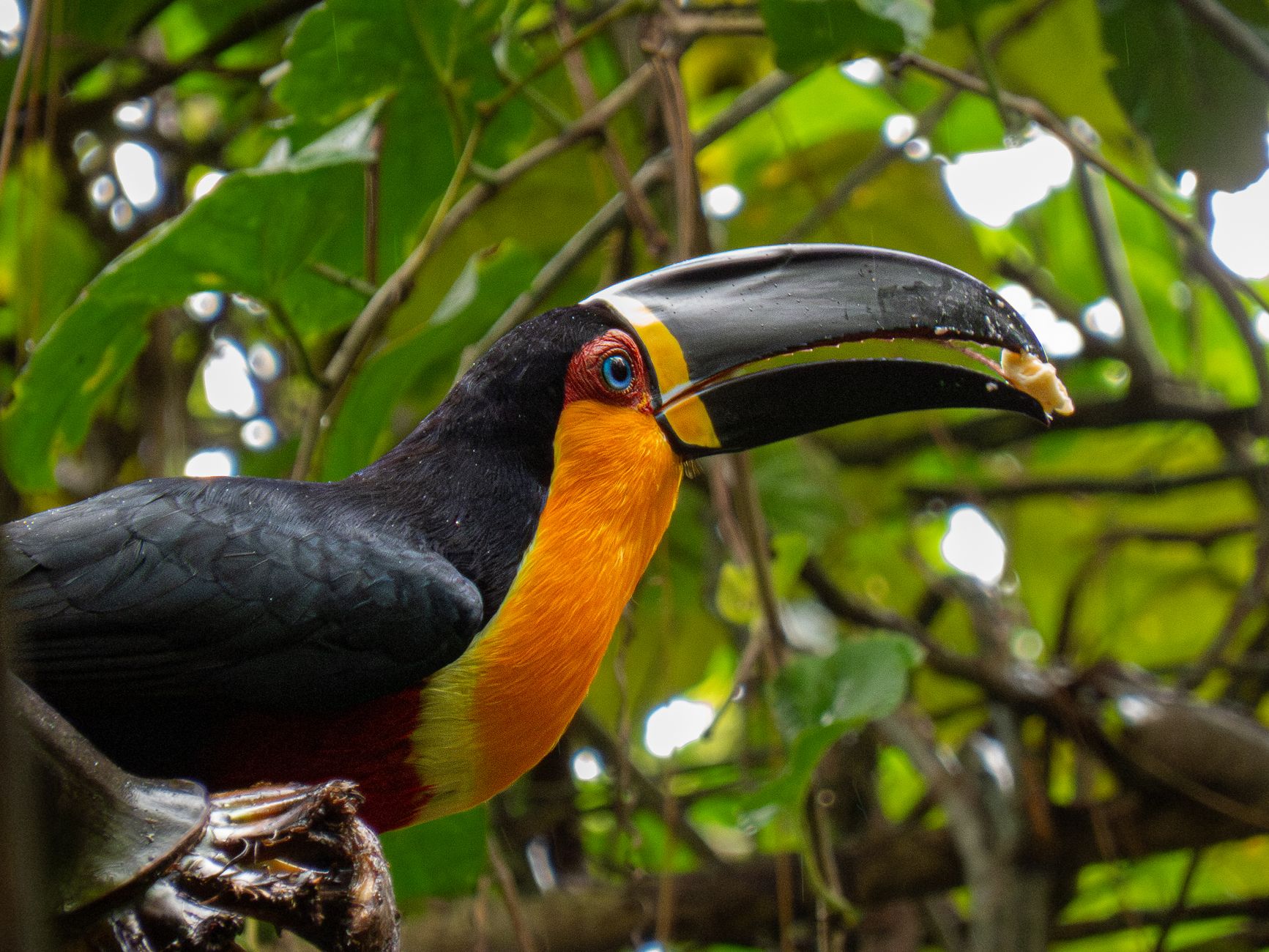
Researchers at Cornell University are developing an artificial intelligence system trained on thousands of hours of rainforest audio to identify bird species across the Amazon, tackling a persistent obstacle in tropical ecology: many birds in dense forest canopy are heard far more often than they are seen. By feeding the AI large volumes of recorded bird calls from the Amazon basin, the team is building a tool capable of distinguishing species that visual surveys routinely miss because of thick foliage, low light and birds’ tendency to stay hidden from observers.
The project responds to a well-documented limitation in biodiversity monitoring. Traditional field surveys rely on trained observers spotting and identifying birds by sight, a method that becomes unreliable in rainforest environments where canopy cover can obscure even large or distinctive species. Sound-based identification sidesteps that constraint, allowing researchers to detect species presence purely from calls picked up by recording equipment placed across study sites, then analysed by machine-learning models trained to recognise acoustic patterns unique to each species.
Early Findings Link Bird Diversity to Land Use Choices
Preliminary results from the research indicate that rubber agroforestry systems, where rubber trees are grown alongside other vegetation in a more forest-like structure, support markedly greater bird diversity than land converted to cattle pasture, one of the most common and environmentally disruptive land uses across the Amazon. The comparison gives researchers a data-driven basis for demonstrating how different farming practices affect local wildlife populations, moving the conversation beyond general assumptions about deforestation and toward measurable outcomes tied to specific agricultural models.
That distinction carries practical weight for conservation efforts in the region. Cattle ranching remains a leading driver of deforestation in the Amazon, often replacing biodiverse forest with cleared land that offers little habitat value for native species. Rubber agroforestry, by contrast, retains more of the structural complexity that birds and other wildlife depend on, while still generating income for local farmers. Researchers involved in the project see the AI-driven bird-monitoring data as a way to make that trade-off tangible, giving conservationists and policymakers concrete evidence to encourage a shift away from pasture-based farming.
The broader aim is to connect environmental protection directly to farmer livelihoods rather than treating conservation as a constraint on economic activity. By quantifying the biodiversity benefits of agroforestry, the research offers a potential incentive structure: farmers who adopt more sustainable practices could point to measurable ecological gains, potentially supporting access to certification schemes, conservation payments or market advantages tied to sustainable sourcing.
For audiences in the UAE and wider Gulf region, the project reflects a broader global trend of using artificial intelligence to support environmental monitoring and sustainable land management, an area of growing interest as Gulf governments and institutions expand investment in biodiversity initiatives and climate-related technology programmes. Automated acoustic monitoring tools of the kind being developed for the Amazon could inform similar conservation and agricultural-monitoring efforts in other parts of the world, including desert and coastal ecosystems where visual wildlife surveys face their own environmental constraints.
The research remains ongoing, with the Cornell team continuing to expand its audio dataset and refine the AI models used to classify bird species. As the system improves, researchers expect it to serve as a scalable tool for tracking biodiversity across large and difficult-to-access tropical landscapes, offering a template for pairing conservation science with practical economic incentives for the farmers who manage much of the Amazon’s remaining forest cover.