
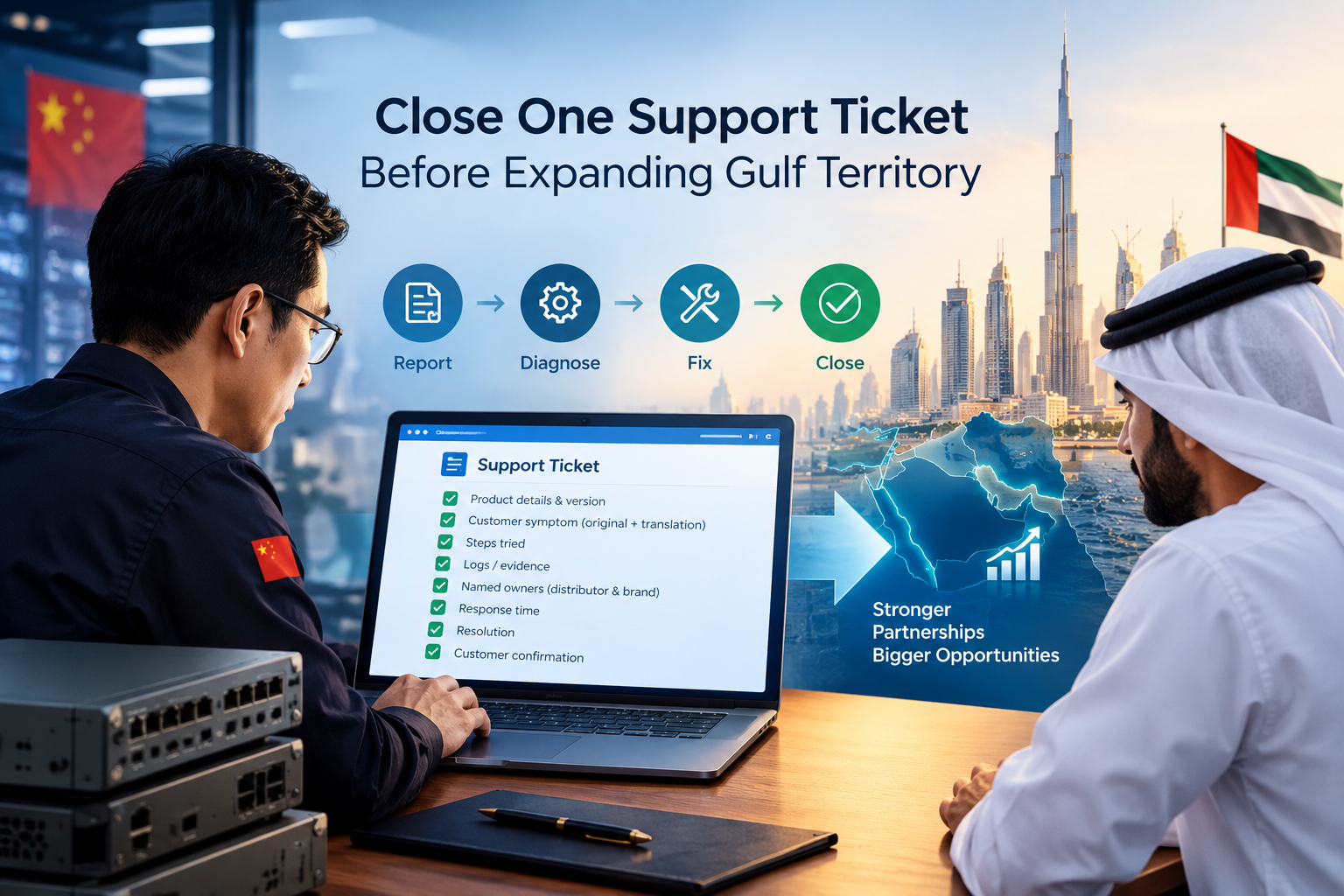
Territory discussions often begin with sales projections, marketing budgets and channel coverage. For a Chinese technology brand entering the Gulf through a local distributor, those numbers matter. Yet they do not show what happens after a customer reports a fault that neither the reseller nor the distributor can immediately solve.
Before expanding territory, the partners should close one controlled support ticket from the first report to the final evidence. The exercise reveals whether the brand and distributor share the same product identity, diagnostic language, escalation path and customer facing answer.
Build one ticket that can survive handoffs
The brand and distributor should use an ordinary product configuration rather than a demonstration unit prepared by headquarters. They should create a support record containing eleven fields:
- The exact model, hardware revision and serial number format.
- The firmware or software version in use.
- The customer’s reported symptom in the original language.
- The distributor’s English or Chinese translation of that symptom.
- The steps already attempted locally.
- The log, image or test result attached to the escalation.
- The named owner at the distributor.
- The named owner at the Chinese brand.
- The next response time promised to the customer.
- The final technical or commercial disposition.
- Proof that the customer facing loop was closed.
This is a support readiness record. It is not evidence that a product meets any legal, cybersecurity, safety, warranty or procurement requirement. Those decisions remain with the responsible organisations and qualified specialists.
Use a deliberately ordinary case
Consider Pearl Route Systems, a fictional UAE distributor, and Suyin Network Devices, a fictional Chinese manufacturer. Every company, device, customer, ticket, file and outcome in this example is invented.
Pearl Route has sold ten compact network gateways to a small facilities operator. One unit disconnects from the local dashboard after an update, although basic network access remains available. The distributor can restore the connection by restarting the device, but the issue returns the following morning.
For the controlled ticket, the distributor records the exact model and revision, the installed version, the dashboard error and two timestamps. It attaches a redacted event log and records the restart already attempted. The local engineer writes a two sentence customer description in English while retaining the original Arabic wording rather than replacing it.
At 09:20 Gulf time, the distributor sends the escalation through the agreed support channel. Headquarters acknowledges it at 12:05 and asks for a log from a menu that does not exist on the distributor’s firmware version.
That mismatch is the first useful result.
The parties discover that the English service guide refers to a newer interface. The manufacturer then supplies the correct path and a version specific diagnostic step. The distributor captures the requested log, headquarters identifies a configuration conflict and the distributor applies the documented correction to the test unit.
The next morning, the dashboard remains connected. Pearl Route sends the customer a plain language explanation and records the customer’s acknowledgement at 10:40.
The technical fix matters, but the workflow evidence matters more. The ticket exposes an obsolete guide, confirms who can retrieve the correct log and shows whether headquarters can respond within the customer’s promised window.
Measure the closure, not the first reply
An automatic acknowledgement is not a closed support case.
The partners should evaluate four intervals:
- Customer report to distributor ownership.
- Distributor ownership to complete escalation.
- Complete escalation to an actionable manufacturer response.
- Corrective action to customer confirmation.
They should also track rework.
If headquarters asks three times for identifiers that should have been captured in the first form, the ticket is not ready to scale. If the distributor translates the symptom so broadly that the original meaning disappears, the escalation has lost evidence. If the customer never receives a final explanation, the internal resolution is not complete from a commercial perspective.
The partners should retain the original symptom, attachments and version history. A corrected translation can sit beside the first translation, but it should not erase it.
The same principle applies to service guides. Replacing an obsolete document without recording its version makes it difficult to determine which distributors may still be using it.
Separate the partnership decisions
The exercise should produce three decisions.
The distributor decides whether its staff can identify the product, collect the necessary evidence and communicate a reliable next step.
The Chinese brand decides whether its support team can interpret Gulf field evidence, return version specific instructions and name an accountable owner.
Both parties decide whether the customer facing promise matches the actual handoff time.
A strong distributor may still uncover a weak manufacturer escalation path. A capable manufacturer may discover that the distributor lacks access to logs or keeps incomplete installation records.
Those are repairable findings when they are discovered in one controlled case. They become expensive when they remain hidden behind a larger territory.
Use a four way territory rule
The partners can expand the distributor’s territory when the first escalation contains the required identifiers and evidence, headquarters provides an actionable version specific response, the distributor validates the correction and the customer receives a documented closeout.
They should repeat the ticket without expanding territory when the issue is solved but required fields, translations, owners or response times remain incomplete.
They should narrow the territory or product range when support works for one configuration but the distributor lacks the tools, training or parts required for other models. A limited authorisation can then match the support capability already demonstrated.
They should stop the expansion when product identity cannot be established, field evidence cannot reach an accountable manufacturer owner, instructions do not match the installed version or the customer facing loop remains open.
Support capacity is part of channel capacity
The Gulf is not one service desk. A distributor may cover several countries, languages, reseller layers and customer types. Granting more territory increases the distance between a field symptom and the engineer who can interpret it.
One controlled support ticket cannot predict every failure. It can, however, show whether the partnership preserves evidence across that distance.
For a Chinese technology brand, this is a practical test of local representation. The distributor must do more than forward messages, while headquarters must do more than issue generic instructions.
Territory should follow demonstrated support capacity.
When the partners can close one ordinary case with correct product identity, traceable evidence, named owners and a customer facing conclusion, they have a stronger and more defensible basis for expanding the channel.