For much of the early AI conversation, the focus was on how quickly technology could help businesses adapt what already existed.
Translate the campaign. Localise the message. Generate another version. Produce more content for another market.
But as AI makes those tasks increasingly inexpensive, the competitive question is changing.
What does the Gulf create that cannot simply be copied?
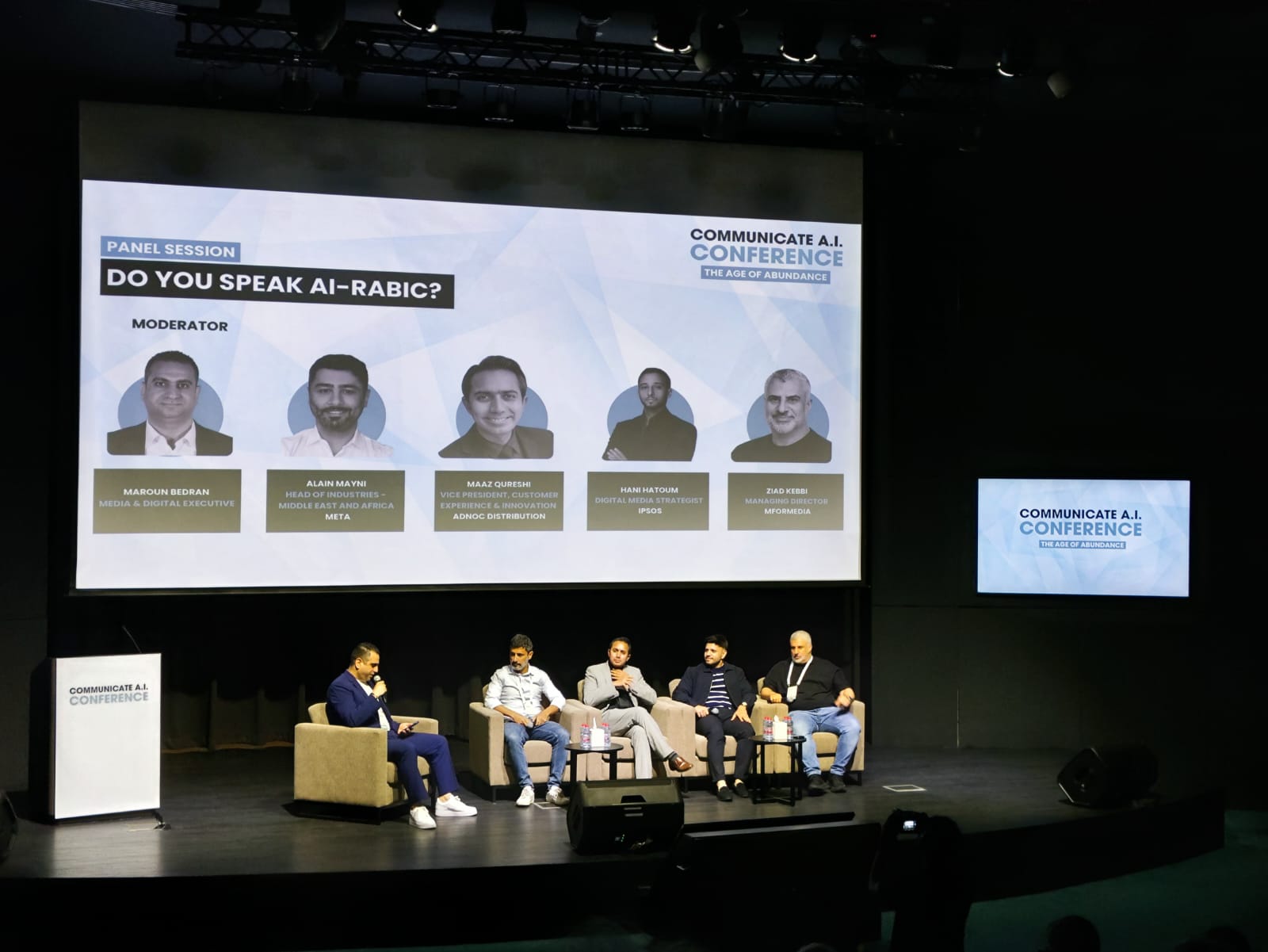
That was the central question behind “Do You Speak AI-rabic?”, a panel at Communicate A.I. Conference 2026 in Dubai that looked beyond AI adoption and towards the region’s ability to originate its own intellectual property, technology and commercial models.
The session brought together Ziad Kebbi, Managing Director of MFORMEDIA; Alain Mayni, Head of Industries for Middle East and Africa at Meta; Maaz Qureshi, Vice President of Customer Experience & Innovation at ADNOC Distribution; and Maroun Bedran, Media and Digital Executive.
The premise was straightforward: when adaptation becomes free, originality becomes the advantage.
That has particular significance in the Gulf.
The region has become highly effective at bringing global technologies, brands and business models into local markets. But generative AI potentially changes the economics of that model. If a company can adapt language, imagery and messaging at increasingly low cost, localisation itself becomes less of a differentiator.
The harder challenge is creating something from the region that has value beyond it.
That could mean Arabic-first AI tools designed around the way people actually communicate across the region. It could mean original entertainment formats, locally developed intellectual property, regional data and computing infrastructure, or business models built around the specific needs of MENA markets.
The distinction is important because Arabic is not simply another translation layer.
The Arab world contains multiple dialects, cultural references and communication styles across countries and communities. A piece of content can be linguistically correct and still feel completely wrong to its intended audience.
That creates an opportunity for companies developing AI systems for Arabic users.
Instead of asking AI to adapt a global product into Arabic, the bigger opportunity may be building products where Arabic and regional context are considered from the beginning.
For businesses, this is also becoming an infrastructure question.
Building competitive AI products requires more than good prompts or access to a consumer chatbot. Companies increasingly need access to computing power, data, engineering talent, investment and distribution.
That means the region’s AI ambitions are connected to a much wider ecosystem.
Technology companies need customers. Founders need capital. Media companies need new forms of intellectual property. Corporates need solutions that can operate at scale. Governments and infrastructure providers can help create the conditions in which those different parts of the ecosystem connect.
The panel brought these perspectives together through four professionals working across media, technology, customer experience and digital business.
Ziad Kebbi represents the media and production side of the equation through MFORMEDIA, where changing technology directly affects how content and commercial storytelling are produced.
Alain Mayni brings the perspective of Meta and a global technology platform operating across Middle Eastern and African markets, providing a view of how businesses and consumers are adopting increasingly AI-driven tools.
Maaz Qureshi represents a major regional corporate through ADNOC Distribution, where customer experience and innovation have to move beyond experimentation and produce practical value for a large-scale business.
Maroun Bedran adds a broader media and digital perspective to a conversation about where technology, audiences and regional content intersect.
But the most interesting element of the session was its focus on commitments rather than predictions.
Each panelist was asked to conclude with one initiative they intended to build or advance over the following 12 months.
That changed the nature of the conversation.
AI conferences are full of forecasts about what will happen next. The technology itself changes quickly enough that many predictions can become outdated within months.
A commitment is different.
It asks what an executive or organisation is actually prepared to do.
That could be an investment in an Arabic-first product, a new media property, an AI-enabled customer experience, new infrastructure or another initiative capable of turning the regional AI opportunity into something tangible.
The emphasis on action also reflects a broader shift taking place across the UAE.
Dubai and Abu Dhabi have spent years building technology, media, financial and entrepreneurial ecosystems designed to attract global companies and talent. The next stage of that development is increasingly about whether those ecosystems can also produce companies and intellectual property of their own.
There is a difference between being an important market for AI and becoming a place where AI businesses are created.
The first requires adoption.
The second requires originality.
That is why the language question in the title of the session is more significant than it initially appears.
“AI-rabic” is not simply about whether artificial intelligence can communicate in Arabic. It is about whether the technology can understand and participate in the cultural, commercial and creative environment of the region.
If AI can cheaply reproduce what already exists, then copying becomes less valuable.
The opportunity moves towards what is difficult to reproduce: original ideas, local knowledge, proprietary technology, distinctive cultural expression and businesses designed around regional realities.
For the Gulf, that could become an important competitive question.
The region does not necessarily need to build every layer of the global AI stack. But it does need to identify where its own advantages can produce something difficult for others to replicate.
That may be in Arabic technology. It may be in entertainment and media. It may be in energy, finance, mobility, customer experience or other industries where the region has scale and access to real-world problems.
The challenge is turning those advantages into products rather than simply talking about them.
That was ultimately what made “Do You Speak AI-rabic?” relevant beyond the conference room.
The AI race is increasingly moving from adoption to creation.
And for the Gulf, the question may no longer be whether it can speak the language of AI.
It may be whether it can develop a language of its own.