AI investment is no longer being driven only by the promise of better models or faster technology. The bigger question emerging for investors, founders and governments is what happens after the technology works.
Can it become a business?
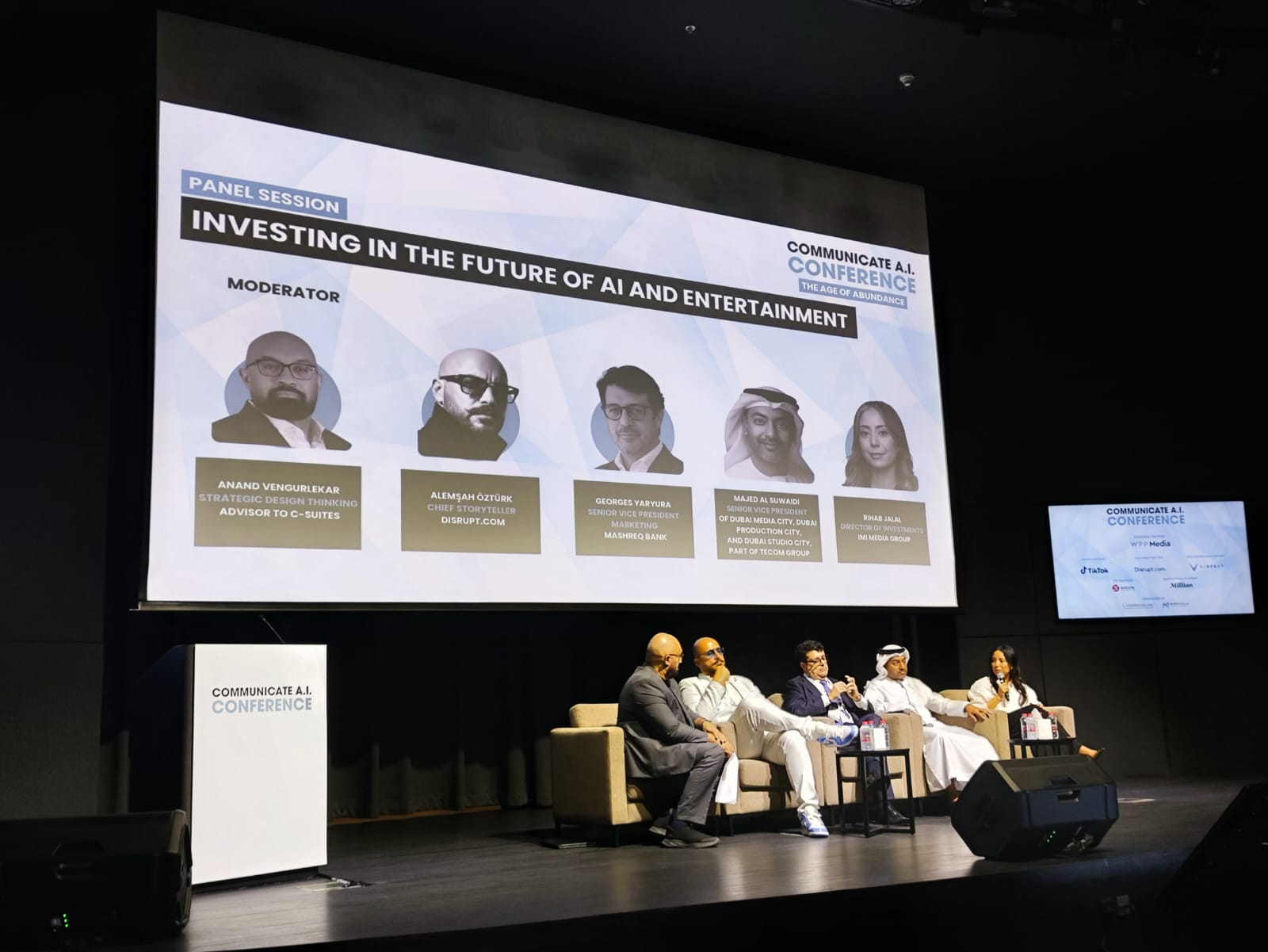
That question shaped the “Investing in the Future of AI and Entertainment” session at Communicate A.I. Conference 2026 in Dubai, bringing together investors, technology and media executives, strategists and creative industry leaders to examine what it takes to move AI ventures from promising ideas into sustainable companies.
The discussion came at a time when artificial intelligence is increasingly influencing both sides of the entertainment equation. It is changing how content is developed, marketed and distributed, while simultaneously creating new companies around infrastructure, software, production and audience engagement.
But access to technology alone does not create an investable business.
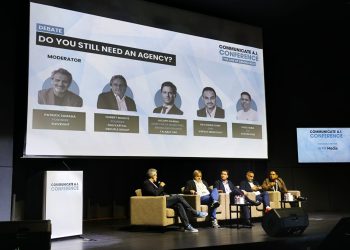
The panel brought together Georges Yaryura, Senior Vice President Marketing at Mashreq Bank; Majed Al Suwaidi, Senior Vice President of Dubai Media City, Dubai Production City and Dubai Studio City, part of TECOM Group; David Fregonas, Song Marketing Lead Middle East & Africa at Accenture Song; Anand Vengurlekar, Strategic Design Thinking Advisor to C-suites; Rabih I. Khoury, General Partner at Middle East Venture Partners; Rihab Jalal, Director of Investments at IMI Media Group; and Alemşah Öztürk, Chief Storyteller at Disrupt.com.
The range of backgrounds was significant because AI investment increasingly cuts across industries rather than sitting neatly within the technology sector.
For an investor, product–market fit remains fundamental. A technically impressive product still needs customers willing to pay for it, a market large enough to support growth and a business model capable of surviving beyond the initial excitement around AI.
For founders, however, the challenge is broader.
Building an AI company can require access to specialised talent, significant computing resources, data, capital and distribution. For a young company competing with much larger technology businesses, these requirements can become barriers before the product has even reached scale.
This is where the idea of an ecosystem becomes important.
Dubai has spent years building an environment around media, technology, production and entrepreneurship. The presence of Dubai Media City, Dubai Production City and Dubai Studio City, under TECOM Group, reflects the city’s attempt to bring different parts of the creative economy into close proximity.
The AI opportunity adds another layer to that ecosystem.
A media company may have audiences and intellectual property but need technology. A technology startup may have the technology but lack distribution. An investor may have capital but need access to founders and markets. A creative business may understand storytelling but require computing infrastructure and new production capabilities.
The commercial opportunity lies partly in connecting those pieces.
That was particularly relevant to the entertainment side of the conversation.
AI is already challenging assumptions about the economics of content production. Production workflows can be accelerated, creative concepts can be tested more quickly and marketing assets can be adapted for multiple markets. At the same time, AI is creating questions around intellectual property, originality, ownership and the role of human creators.
For investors, those questions cannot be separated from the business case.
A company developing an AI tool for entertainment needs more than a compelling demonstration. It needs a defensible product, a clear customer and a path to scale. It also needs to understand how its technology fits into an industry where relationships, rights, talent and distribution can be as important as software.
This is where the MENA market presents an interesting opportunity.
The region is no longer simply a consumer market for technology developed elsewhere. Governments, sovereign investors, financial institutions, media groups and private investors are increasingly looking at how technology can be developed, deployed and commercialised from the region.
Dubai’s position as a business and media hub gives startups potential access to companies, investors, production infrastructure and international markets within the same ecosystem.
But access alone does not guarantee success.
The panel’s focus on strategic partnerships points to another reality of the AI economy: startups may need to collaborate much earlier than traditional technology companies did.
A founder might need a bank to validate a financial application, a media group to test a content product, a major technology provider for infrastructure, an investor for capital and an established corporate partner to reach customers.
That makes ecosystem building more than a government or infrastructure project. It becomes part of the commercial strategy.
The participation of Rabih I. Khoury of Middle East Venture Partners and Rihab Jalal of IMI Media Group brought investment directly into a discussion otherwise populated by marketing, media and strategy executives. Their presence reflected the increasing overlap between capital and content as AI changes the economics of both.
Entertainment is also becoming an increasingly important testing ground for AI.
The sector has traditionally adopted new technologies when they could reduce production costs, improve distribution or create new forms of storytelling. AI potentially affects all three.
For companies operating in the region, however, there is another opportunity: creating content and intellectual property that is designed for MENA audiences rather than simply adapting global material.
That could mean Arabic-first products, locally developed entertainment formats, new creator businesses or technology companies building tools around regional languages and cultural contexts.
The investment question then becomes more interesting.
Rather than asking only whether AI will disrupt entertainment, investors and companies have to ask which businesses will emerge because of that disruption.
That distinction was central to the broader agenda of Communicate A.I. Conference 2026. Across the programme, discussions moved between AI-generated advertising, Arabic innovation, tourism, marketing, agentic AI and the changing creator economy.
The common thread was the transition from experimentation to commercialisation.
There is no shortage of AI ideas. The harder task is building companies around them.
That requires customers, talent, capital, infrastructure, partnerships and access to markets. It also requires an ecosystem capable of connecting those resources at the point when a promising idea needs to become an operating business.
For Dubai and the wider MENA region, that may ultimately be the more consequential AI investment story.
The opportunity is not simply to attract companies working on artificial intelligence.
It is to create the conditions in which technology, capital, media, entertainment and creative talent can interact closely enough to produce companies that can scale beyond the region.
AI may provide the technology.
But the businesses that emerge from it will depend on everything around the technology.