Two technologies are shaping the architecture of the twenty-first century in profoundly different ways. One tries to make machines think. The other tries to make institutions trust. Artificial intelligence asks a question that has fascinated humanity for centuries: Can intelligence be reproduced? Blockchain asks a different question: Can trust be redesigned?
AI attempts to replicate, augment and increasingly extend some of the cognitive abilities of human beings. It learns patterns, generates language, recognizes images, writes code, produces music and assists with decisions.
Blockchain does something almost opposite. It does not try to make a machine think like a human. It creates systems in which people, institutions and machines can coordinate without necessarily having to trust a central intermediary.
One technology is about intelligence. The other is about trust. One learns. The other remembers. One predicts. The other records. One generates possibilities. The other creates verifiable history. And this leads to a fascinating question: Blockchain or AI—which one is more human?
At first glance, the answer seems obvious. AI speaks our language. It writes our stories. It imitates our creativity. It can hold conversations. It recognizes emotional patterns. It increasingly behaves in ways that appear remarkably human.
Blockchain, by contrast, is cold, mathematical and mechanical. It consists of blocks, hashes, cryptographic signatures, consensus mechanisms and distributed networks. There is apparently nothing human about it.
Yet perhaps appearances are misleading. Because beneath the mathematics of blockchain lies one of the oldest human problems in civilization: How can strangers trust one another? And beneath the sophistication of artificial intelligence lies another ancient human aspiration: How can intelligence exist beyond the individual mind?
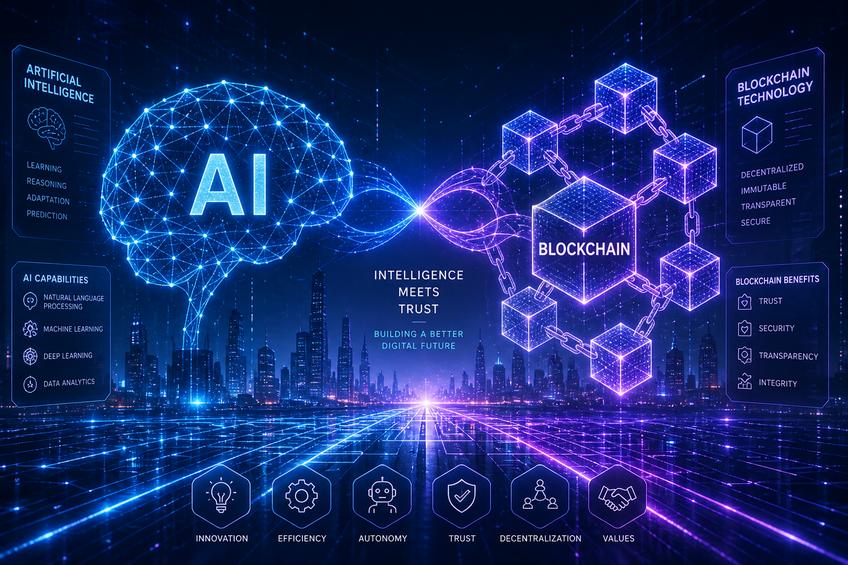
Perhaps AI and blockchain represent two different dimensions of humanity. AI represents our desire to reproduce intelligence. Blockchain represents our desire to institutionalize trust. And the future may belong not to one or the other, but to the combination of both.
AI: The Machine That Tries to Understand Us
Artificial intelligence is often described as the attempt to make machines intelligent. But the word “intelligence” is itself deeply human. For thousands of years, philosophers have asked what makes a person intelligent. Is it memory? Reason? Language? Creativity? Problem-solving? Self-awareness? Judgment? Emotion? Wisdom?
AI has entered this philosophical territory because it can now perform tasks once considered uniquely human. A machine can write an essay. It can translate a language. It can analyze a legal document. It can compose music. It can create an image from a sentence. It can help design a building. It can summarize a scientific paper. It can write computer code. It can carry on a conversation. As AI becomes more sophisticated, the boundaries between human and machine capabilities become increasingly difficult to define. But there is an important distinction.
AI can reproduce many forms of human output without necessarily reproducing human experience. A machine can describe love without falling in love. It can write about grief without losing someone. It can describe childhood without having one. It can discuss death without fearing its own mortality. It can produce a poem about loneliness without necessarily experiencing loneliness. This distinction may remain one of the deepest differences between artificial and biological intelligence. Human intelligence is embodied.
It exists within a living organism. It is shaped by hunger, fear, desire, memory, relationships, mortality and physical experience. AI intelligence is fundamentally different. It emerges from computation, data, algorithms and statistical patterns.
Yet perhaps this difference does not make AI less important. It makes it different. AI is becoming a new form of intelligence—one that does not need to be identical to human intelligence to transform human civilization.
Blockchain: The Technology That Tries to Understand Trust
Blockchain begins somewhere else entirely. Before blockchain, digital information had a fundamental problem. Digital information can be copied. If I send you a digital photograph, I still have the original. If I send you a digital document, I can potentially keep a copy. If I send you a digital asset, how do we know that it has not been duplicated? The traditional solution was the intermediary.
Banks verify financial transactions. Governments verify identity. Registries verify ownership. Notaries verify documents. Companies maintain databases. Institutions act as trusted authorities.
Blockchain proposes another possibility. Instead of trusting a single central institution, participants can rely on a distributed system in which transactions are cryptographically secured and collectively validated. This is a radical idea. Because trust is one of the foundations of civilization.
Human beings have always needed ways to establish trust between people who do not know each other. Money is a trust system. Property is a trust system. Contracts are trust systems. Legal identity is a trust system. Markets are trust systems. Institutions exist partly because strangers need mechanisms for cooperation.
Blockchain therefore addresses something profoundly human. It is not primarily trying to make machines human. It is trying to solve a human problem: How do we cooperate when we cannot personally trust one another?
AI Is About Intelligence. Blockchain Is About Trust.
This distinction may be the key to understanding the two technologies. AI asks: What can intelligence do? Blockchain asks: What can trust do?
AI allows machines to process enormous amounts of information and generate outputs. Blockchain allows networks to establish shared records without relying entirely on one central authority. AI can create. Blockchain can authenticate. AI can predict. Blockchain can verify. AI can personalize. Blockchain can decentralize. AI can generate an answer. Blockchain can establish a record.
These differences are not merely technical. They represent different philosophies of digital civilization.
AI is fundamentally probabilistic. It works with patterns and possibilities. Blockchain is fundamentally deterministic in its record-keeping function. It establishes what happened according to the rules of the network. AI says: “This is probably the answer.” Blockchain says: “This transaction is recorded according to the agreed rules.” That contrast is extraordinary. One technology deals with uncertainty. The other deals with certainty. Human civilization needs both.
The Human Need for Memory
There is another sense in which blockchain may be surprisingly human. Human beings are creatures of memory. Civilizations survive because they remember. We preserve treaties. We record property. We write constitutions. We keep financial accounts. We create archives. We preserve photographs. We build monuments. We write history. Memory allows societies to maintain continuity across generations.
Blockchain introduces the possibility of highly resistant digital records. Once information is recorded and sufficiently confirmed on a blockchain, changing historical records can become extremely difficult depending on the network and its governance. In this sense, blockchain is a kind of digital memory.
AI, by contrast, is more naturally associated with interpretation. It looks at information and attempts to make sense of it. Blockchain remembers what the network has agreed happened. AI asks: What does this information mean? Blockchain asks: What information can we agree is authentic?
Both are essential. Human civilization needs memory and interpretation. Without memory, society loses its history. Without interpretation, history becomes meaningless data.
The Human Need for Creativity
If blockchain resembles human memory, AI resembles human imagination. Humans create worlds before those worlds exist. We imagine cities. We invent stories. We design machines. We compose music. We imagine political systems. We construct theories. AI increasingly participates in this process.
Generative AI can create something that did not previously exist as a specific object. That makes AI particularly fascinating. It is not simply storing human creativity. It is becoming a tool through which new forms of creativity emerge. But this raises an important question: Does creativity belong to the machine, the human, or the relationship between them?
A photographer uses a camera. A musician uses an instrument. An architect uses software. A scientist uses a laboratory. AI may become another instrument of creation.
The final creative act may therefore not be “AI versus human.” It may be human with AI.
The human provides intention. The machine provides possibility. The human selects. The machine generates. The human judges. The machine explores. That relationship could become one of the defining creative partnerships of the century.
Blockchain and the Human Desire for Freedom
There is another deeply human dimension to blockchain: the desire for autonomy. Throughout history, individuals have struggled with centralized power. Political power. Financial power. Institutional power. Information power.
Blockchain emerged partly from a technological culture that questioned whether financial and digital systems should depend entirely on centralized intermediaries. The idea of decentralization therefore has a political and philosophical dimension.
Who controls the network? Who controls the records? Who can change the rules? Who owns the asset? Who can participate? These are not merely technical questions. They are questions about power.
Blockchain does not automatically produce freedom. Decentralization can introduce new problems. Governance can become complicated. Power can accumulate in different parts of a network. Economic inequality does not disappear because a system uses blockchain.
But the technology provides a new architecture for thinking about authority. And that is inherently human. Human history is, among other things, a history of negotiating power.
AI and the Human Desire for Knowledge
AI represents another ancient human aspiration: the desire to know. Humans have always tried to extend the limits of knowledge.
The telescope expanded our vision. The microscope expanded our perception. The computer expanded our capacity to calculate. The internet expanded access to information. AI may expand our ability to synthesize and reason across information. That could be transformative.
A scientist can use AI to explore millions of possibilities. A doctor can use AI to identify patterns in medical data. A student can interact with a personalized educational system. An entrepreneur can test hundreds of ideas. A policymaker can model complex scenarios. The machine becomes an intellectual amplifier.
But knowledge without judgment is dangerous. AI may know more facts while still failing to understand what matters. It can tell us what is possible. It cannot automatically tell us what is desirable. That remains a human responsibility.
Blockchain and the Human Desire for Fairness
Blockchain also appeals to another human aspiration: fairness. The idea that rules should apply consistently to everyone is central to many concepts of justice.
A blockchain protocol can encode rules that determine how transactions are validated and how assets move. This can create predictability. But predictability is not the same as justice. A perfectly consistent system can still produce unfair outcomes if the rules themselves are unfair.
This distinction is critical. Code can enforce rules. It cannot automatically determine whether the rules are morally right. That requires human judgment. In other words: Blockchain can automate trust, but it cannot automatically define justice.
The same principle applies to AI. AI can automate decisions. But automation does not make a decision ethical. Both technologies therefore ultimately return responsibility to human beings.
Which Technology Is More Human?
Perhaps we can now answer the question differently. If “human” means communication, creativity, language and cognitive behavior, AI appears more human. If “human” means trust, ownership, memory, cooperation and the organization of society, blockchain may be equally human—or perhaps even more deeply connected to the foundations of civilization.
AI imitates some characteristics of the human mind. Blockchain formalizes some characteristics of human society. That is an important distinction.
AI asks what happens when intelligence becomes computational. Blockchain asks what happens when trust becomes computational. One digitizes cognition. The other digitizes agreement. And both are fundamentally transformations of human institutions.
AI Without Blockchain
Imagine a future in which AI systems become extraordinarily powerful. They create financial decisions. They generate contracts. They manage digital identities. They make recommendations. They negotiate transactions. They create digital assets.
But who verifies what they have done? Who owns the output? Can the output be authenticated? Can its origin be established? Can we prove that a particular AI agent made a particular decision? Can we establish ownership? Can we create a trustworthy history of interactions?
These questions point toward blockchain. Blockchain could provide infrastructure for identity, ownership, provenance and transaction records within an AI-driven economy. AI could generate the intelligence. Blockchain could provide the trust layer.
Blockchain Without AI
Now imagine the opposite. A global blockchain infrastructure securely records enormous quantities of transactions. But humans must manually interpret everything. The system may be secure but inefficient.
There may be billions of transactions. Millions of digital assets. Complex smart contracts. Large-scale decentralized organizations. How do humans manage this complexity?
AI becomes useful. AI can analyze blockchain data. Identify patterns. Detect anomalies. Assist with governance. Help users interact with decentralized applications. Explain complex smart contracts. Monitor transactions. Provide personalized interfaces.
AI becomes the intelligence layer. Blockchain becomes the trust layer. The combination could be far more powerful than either technology independently.
The Emergence of Autonomous Digital Agents
Perhaps the most interesting future lies at their intersection. Imagine AI agents that can operate independently.
An AI agent could negotiate a contract. Purchase computing resources. Pay another AI agent. Access a decentralized service. Verify ownership through blockchain. Receive payment. Create a new digital asset. And record the entire process on a blockchain.
This would create something very different from today’s internet. The internet was largely designed for humans consuming and exchanging information. The emerging AI-blockchain environment could be designed for machines transacting with machines on behalf of humans. That could transform the economy.
An AI agent could represent an individual. Another could represent a company. Another could represent a scientific institution. They could negotiate continuously. Human beings would establish the objectives and limits. Machines would perform the transactions. Blockchain could provide the shared trust infrastructure. AI could provide the intelligence.
The result could be a new digital economy in which human beings increasingly interact indirectly through autonomous software.
That possibility is exciting. It is also dangerous. Because the more autonomy we delegate to machines, the more important governance becomes.
The Risk of Combining Intelligence and Trust
AI alone creates risks. Blockchain alone creates risks. Their combination could create entirely new ones.
Imagine an AI agent capable of making decisions and a blockchain capable of executing those decisions automatically. The AI identifies an opportunity. A smart contract executes the transaction. The transaction transfers assets. The AI learns from the outcome. It repeats the process. The cycle becomes increasingly autonomous.
Now imagine the objective was poorly defined. The AI may optimize the wrong thing. The blockchain may execute the resulting actions perfectly.
This reveals a profound principle: Blockchain can make AI more powerful because it gives AI reliable mechanisms for ownership and execution. But that also means blockchain can make an AI error more consequential.
The blockchain will faithfully execute the rules. It does not know whether the rules were wise. This is why the combination of AI and blockchain requires stronger governance, not weaker governance.
The Future May Not Be AI Versus Blockchain
The debate often asks which technology will dominate. That may be the wrong question. The future is unlikely to be AI versus blockchain. It is more likely to be AI with blockchain.
The two technologies solve different problems. AI addresses intelligence. Blockchain addresses trust. AI can generate information. Blockchain can verify transactions. AI can act as an agent. Blockchain can provide the infrastructure through which agents interact. AI can analyze. Blockchain can record. AI can personalize. Blockchain can establish ownership. AI can predict. Blockchain can execute according to predefined rules. Together, they could form a new architecture for digital civilization.
What Does It Mean to Be Human?
Ultimately, however, the question “Which one is more human?” is not really about technology. It is about us.
Human beings are intelligent. But they are also emotional. They remember. They forget. They trust. They distrust. They cooperate. They compete. They create. They destroy. They seek freedom. They seek security. They want certainty. They live with uncertainty.
AI reflects our intelligence. Blockchain reflects our attempts to organize trust. Neither technology captures the entirety of humanity. And perhaps neither should.
The danger would be to imagine that technology can replace the human qualities that give civilization meaning. AI can help us reason. Blockchain can help us coordinate.
But neither can decide what constitutes a meaningful life. Neither can determine what we owe one another. Neither can tell us why justice matters. Neither can answer the question of what future generations deserve. Those remain human questions.
The Human Future Is Hybrid
The twenty-first century may therefore not produce a world dominated by artificial intelligence or blockchain. It may produce a hybrid civilization in which intelligence and trust are increasingly digital.
AI will become the cognitive layer. Blockchain may become part of the trust and ownership layer. Robotics may become the physical layer. Biotechnology may become the biological layer. Quantum technologies may eventually transform computation and security. Together, these technologies could create an environment in which the boundaries between physical and digital civilization become increasingly difficult to separate.
The central challenge will not be technological capability. It will be human governance.
We will need to decide where machines should act autonomously. Where humans must remain responsible. What should be decentralized. What should remain under institutional control. What information should remain private. What decisions require human consent. And what values should never be reduced to algorithms.
The Final Paradox
So, which is more human? AI or blockchain? Perhaps the answer is neither. Or perhaps the answer is both—but for completely different reasons.
AI is human because it reflects our ancient desire to understand intelligence, reproduce knowledge and extend the boundaries of the mind.
Blockchain is human because it reflects our equally ancient desire to trust, remember, own, cooperate and protect ourselves from arbitrary power.
AI represents the human mind projected into machines. Blockchain represents human social trust projected into mathematics. One tries to make machines think. The other tries to make networks agree.
One asks: “What can intelligence become?” The other asks: “What can trust become?” And perhaps the future of civilization will depend on the intersection of those two questions.
Because intelligence without trust can become dangerous. Trust without intelligence can become inefficient. But intelligence combined with trustworthy infrastructure could create something entirely new. The most important technology of the future may therefore not be AI. It may not be blockchain. It may be the architecture that allows them to work together while keeping human beings at the center.
Machines may become more intelligent. Networks may become more autonomous. Transactions may become more decentralized. Digital identities may become more sophisticated. But the ultimate question will remain unchanged: What kind of civilization do we want to build?
AI may help us imagine it. Blockchain may help us organize it. But only human beings can decide what it should mean.