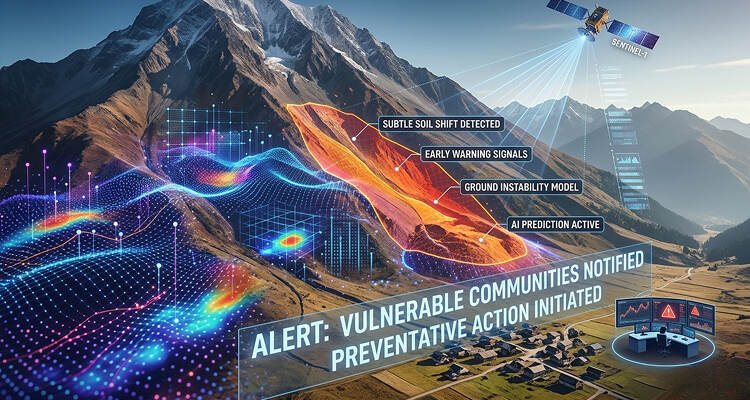
By examining the growing relationship between artificial intelligence, forecasting science, and emergency management, a new question emerges: can machines help humanity outrun nature’s most destructive forces?
On the morning of December 26, 2004, walls of water surged across the Indian Ocean after a massive undersea earthquake near Sumatra triggered one of the deadliest tsunamis in recorded history. More than 230,000 people lost their lives across fourteen countries. In many coastal communities, residents had little or no warning that disaster was approaching.
Nearly two decades later, the technological landscape has changed dramatically. Satellites continuously scan Earth’s atmosphere and oceans. Millions of sensors record seismic vibrations, rainfall, river levels, and temperature changes every second. Supercomputers process enormous streams of information in real time. Increasingly, artificial intelligence stands at the center of this global monitoring effort.
The question that once belonged to science fiction is now being asked by governments, scientists, and citizens alike: could AI inform us about natural disasters before they happen?
The answer is complex. Artificial intelligence cannot stop earthquakes, hurricanes, floods, or wildfires. Nor can it predict every disaster with certainty. Yet experts argue that AI may transform humanity’s ability to anticipate, prepare for, and respond to some of nature’s deadliest events.
The Growing Cost of Natural Disasters
Natural disasters are becoming increasingly expensive and destructive. According to international disaster monitoring agencies, climate-related catastrophes have risen significantly over the past several decades. Rising global temperatures contribute to stronger storms, prolonged droughts, and more intense heatwaves.
The economic damage is staggering. Hurricanes destroy infrastructure worth billions of dollars. Floods wipe out homes and businesses in hours. Wildfires consume entire communities and ecosystems. Beyond financial losses lies an even greater cost: human lives.
Traditional forecasting methods have improved substantially over the years, but they face limitations. Meteorologists use mathematical models to predict weather patterns. Seismologists analyze tectonic movements to understand earthquake risks. Hydrologists study rivers and rainfall to estimate flooding potential.
These methods depend heavily on human expertise and computational models that may struggle to process the enormous complexity of Earth’s natural systems.
Artificial intelligence offers something different.
Machine learning systems excel at identifying patterns hidden within vast amounts of data—patterns that human analysts might overlook or require years to discover.
In disaster prediction, those hidden patterns can mean the difference between evacuation and tragedy.
AI and the Science of Prediction
Artificial intelligence learns by analyzing examples. Feed an AI system decades of satellite images, weather records, ocean temperatures, and atmospheric pressure measurements, and it begins to recognize relationships between them.
For instance, a machine learning model might discover subtle combinations of sea surface temperatures and wind conditions that often precede hurricane intensification.
Unlike traditional programming, where engineers explicitly define rules, AI systems develop their own predictive relationships from data.
This capability is particularly valuable because natural disasters rarely result from a single factor.
Floods depend on rainfall, soil saturation, terrain, urban infrastructure, and river conditions. Wildfires are influenced by humidity, vegetation, wind speed, temperature, and previous burn patterns.
The interactions between these variables create immense complexity.
AI thrives in complexity.
By processing thousands of variables simultaneously, machine learning systems can generate predictions that are faster and, in some cases, more accurate than conventional approaches.
Hurricanes: Forecasting the Storm Before Landfall
Among all natural disasters, hurricanes represent one of AI’s greatest opportunities.
Meteorologists have become increasingly skilled at predicting hurricane paths, but forecasting storm intensity remains challenging. A hurricane can rapidly strengthen within hours, leaving communities with little time to prepare.
Researchers at institutions including NASA, NOAA, and several universities are using AI models to improve these forecasts.
In recent years, machine learning systems have demonstrated impressive results in predicting rapid intensification events. By analyzing satellite imagery and ocean conditions, AI models can identify signs that a storm is about to become significantly stronger.
Google DeepMind and other research groups have also developed AI weather forecasting systems capable of generating accurate predictions in a fraction of the time required by traditional numerical models.
Faster forecasts matter.
Emergency managers often make evacuation decisions based on narrow time windows. Even six additional hours of warning can save lives and reduce economic losses.
For residents living along vulnerable coastlines, better forecasts mean more time to secure homes, gather supplies, and reach safer locations.
Floods: Reading Rivers Through Data
Floods are among the world’s most common natural disasters, affecting millions of people annually.
Predicting floods can be extraordinarily difficult because local geography plays a critical role. Heavy rainfall may produce little impact in one region but catastrophic flooding in another.
AI is changing this equation.
Machine learning models now combine rainfall data, river levels, satellite imagery, topographical maps, and soil moisture measurements to produce highly localized flood forecasts.
Google’s Flood Hub project, for example, uses artificial intelligence to provide flood predictions in multiple countries, particularly in regions where traditional forecasting infrastructure is limited.
In developing nations, where flood warning systems may be underfunded or absent altogether, AI could prove transformative.
A mobile phone alert issued hours before floodwaters arrive can provide enough time for families to evacuate and protect essential belongings.
The technology effectively turns data into time—and in disasters, time is often the most valuable resource.
Wildfires: Detecting Flames Before They Spread
Wildfires have become increasingly severe in regions such as California, Australia, Canada, and Southern Europe.
Climate change, prolonged droughts, and expanding urban development in fire-prone areas have created dangerous conditions.
Artificial intelligence is being deployed on multiple fronts.
Satellite systems equipped with AI algorithms can detect heat anomalies that indicate the early stages of a wildfire. Camera networks positioned in forests use computer vision to identify smoke plumes before they become visible to human observers.
Some systems can recognize fires within minutes of ignition.
Others go further by predicting where a fire is likely to spread.
By analyzing wind conditions, vegetation density, terrain, and humidity, AI models can estimate fire behavior and support firefighting strategies.
This information allows emergency services to prioritize evacuations and allocate resources more effectively.
In wildfire response, every minute counts.
Earthquakes: The Limits of Prediction
Earthquakes present perhaps the greatest challenge for artificial intelligence.
Unlike hurricanes or floods, earthquakes occur with little warning and involve geological processes that remain poorly understood.
Despite decades of research, scientists cannot reliably predict exactly when and where major earthquakes will occur.
AI has not changed this reality.
However, it has improved earthquake early warning systems.
Seismic sensors detect fast-moving primary waves that travel ahead of the more destructive secondary waves responsible for most damage.
AI algorithms can analyze these signals almost instantly, issuing alerts seconds before strong shaking begins.
Seconds may sound insignificant, but they can save lives.
Trains can stop automatically. Gas pipelines can shut down. Surgeons can pause delicate procedures. People can move away from hazardous areas.
Japan, Mexico, and parts of the United States already operate such systems.
Artificial intelligence makes these warnings faster and more reliable.
Prediction remains elusive, but preparation is becoming smarter.
Tsunamis: Watching the Oceans
Tsunamis often follow earthquakes, volcanic eruptions, or underwater landslides.
Detecting them requires monitoring vast ocean regions in real time.
AI systems increasingly analyze data from ocean buoys, pressure sensors, seismic stations, and satellites to estimate tsunami risks more rapidly than traditional methods.
The goal is not merely detection but improved decision-making.
False alarms can lead to costly evacuations and public distrust. Delayed warnings can prove catastrophic.
Machine learning models help authorities strike a better balance between caution and accuracy.
Communities living along coastlines depend on those precious minutes of warning.
Volcanoes and Hidden Signals
Volcanic eruptions produce subtle warning signs before major events occur.
Ground deformation, gas emissions, seismic tremors, and temperature changes often precede eruptions.
The challenge lies in interpreting these signals correctly.
Artificial intelligence can analyze years of volcanic activity data to identify patterns associated with eruptions.
Researchers have begun applying machine learning techniques to volcano monitoring systems around the world.
While the science remains in development, early results suggest that AI may improve eruption forecasts and reduce false alarms.
For communities living near active volcanoes, better forecasting could mean safer evacuations and reduced disruption.
The Satellite Revolution
Modern disaster forecasting depends heavily on satellites.
Every day, satellites capture enormous quantities of information about cloud formations, vegetation health, ocean temperatures, atmospheric moisture, and land movement.
The amount of data exceeds what human analysts can reasonably process.
Artificial intelligence bridges this gap.
Computer vision algorithms examine satellite images continuously, identifying unusual developments that may signal emerging threats.
Changes in vegetation can indicate drought conditions favorable for wildfires. Surface water expansion may reveal flood risks. Ocean temperature anomalies can signal hurricane development.
The result is a planet under constant observation.
AI acts as an ever-vigilant analyst, scanning for danger around the clock.
The Problem of False Confidence
Despite its promise, artificial intelligence carries significant risks.
Machine learning systems are only as good as the data they receive.
Incomplete records, biased datasets, and faulty sensors can produce inaccurate predictions.
Overreliance on AI may create false confidence among policymakers and the public.
A missed forecast could undermine trust in warning systems. False alarms could encourage people to ignore future evacuation orders.
Experts emphasize that AI should support human decision-making rather than replace it.
Meteorologists, geologists, emergency managers, and local authorities continue to play essential roles.
Artificial intelligence is a tool—not an oracle.
The Challenge of Inequality
Access to AI forecasting technology remains uneven.
Wealthier nations possess advanced satellites, extensive sensor networks, and powerful computing resources.
Many lower-income countries do not.
Ironically, some of the regions most vulnerable to natural disasters often have the least access to advanced warning systems.
International organizations are increasingly working to close this gap.
Cloud computing and open-source AI tools may allow developing nations to benefit from sophisticated forecasting technologies without massive infrastructure investments.
The success of disaster prediction should not depend on national wealth.
Nature does not recognize borders.
Ethics and Responsibility
Artificial intelligence introduces difficult ethical questions.
Who bears responsibility if an AI forecast proves wrong?
Should authorities order evacuations based primarily on machine-generated predictions?
How much uncertainty is acceptable when lives and economies are at stake?
These questions have no easy answers.
Transparency becomes crucial.
Experts argue that AI models used in disaster management should be explainable and subject to rigorous testing.
Public trust depends on accountability.
When communities receive evacuation orders, they deserve confidence in the systems behind them.
A Future of Earlier Warnings
The future of disaster prediction will likely combine human expertise with artificial intelligence rather than replace one with the other.
Meteorologists will work alongside machine learning systems.
Emergency managers will integrate AI forecasts with local knowledge and historical experience.
Governments will increasingly rely on real-time analytics to guide public safety decisions.
The direction is clear.
Warnings will arrive earlier.
Forecasts will become more precise.
Responses will become faster.
The ultimate goal is resilience rather than perfection.
No technology can eliminate natural disasters entirely.
But technology can reduce surprise.
Can AI Truly Inform Natural Disasters Before They Happen?
The answer depends on what “inform” means.
If the question is whether artificial intelligence can predict every earthquake, volcanic eruption, or storm with complete certainty, the answer is no.
Nature remains too complex, and scientific understanding remains incomplete.
But if the question is whether AI can provide earlier warnings, improve forecasts, identify hidden risks, and help communities prepare before disaster strikes, the answer is increasingly yes.
Artificial intelligence is already changing how humanity confronts natural hazards.
It detects floods before rivers overflow.
It tracks storms before they make landfall.
It identifies wildfires before smoke reaches the horizon.
It delivers warnings measured not in hours or days alone, but increasingly in moments that can save lives.
For centuries, humans have viewed natural disasters as forces arriving with little notice and limited opportunity for preparation.
Artificial intelligence may not change the power of nature.
It may change our relationship with uncertainty.
And in an era defined by climate change and growing environmental risks, that shift could become one of the most important technological achievements of the twenty-first century.