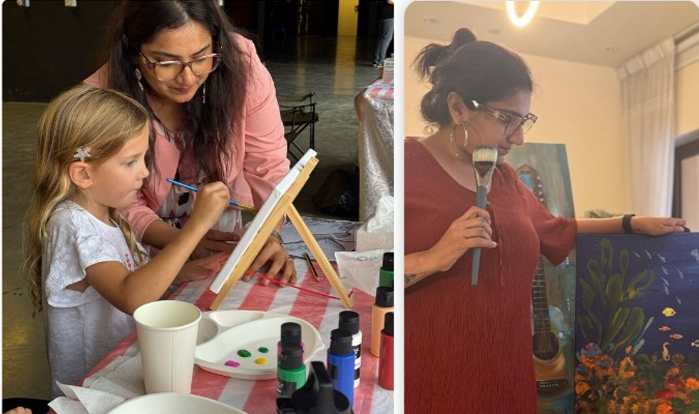
There was a time when I believed art was simply a form of expression — a way to translate emotion into color and form. Over the years, living and working in the UAE has changed that understanding. For me now, art is not just expression. It is responsibility.
The UAE is a place of extraordinary contrasts. It is where desert silence meets architectural ambition, where ancient ecosystems exist alongside rapid transformation. When you live here long enough, you begin to notice not only what is being built, but what is quietly disappearing. That awareness has shaped my practice in ways I could not have anticipated.
Art as an Inner Landscape
I work in a space between abstract realism and surrealism. My paintings are not literal reproductions of nature, nor are they detached abstractions. They exist somewhere in between — grounded enough to be recognizable, yet dreamlike enough to suggest something beyond the visible. That “in-between” space is intentional. It reflects the fragile state of our natural world: present, but increasingly vulnerable.
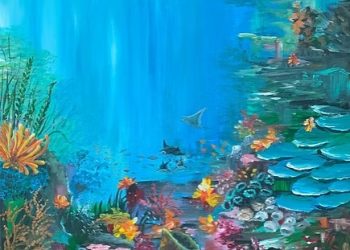
My focus is on endangered species and fading ecosystems. These subjects are not trends for me; they are concerns that linger long after the studio lights are off. When I paint an animal or a landscape, I am not interested in replicating its physical likeness alone. I want to capture its emotional presence — its quiet dignity, its fragility, its right to exist.
The surreal elements in my work often emerge organically. A dissolving horizon, fragmented terrain, or an animal suspended in an undefined space — these are not aesthetic decisions made for visual drama. They are reflections of imbalance. They represent the tension between preservation and progress, between admiration and neglect.
Identity in a Multicultural Context
Living in the Gulf sharpens this awareness. The region’s development is ambitious and inspiring, yet the surrounding desert and marine ecosystems remain delicate. That contrast stays with me. It pushes me to ask difficult questions: How do we grow without erasing? How do we build without forgetting? And where does art stand within that conversation?
For me, art becomes a bridge. It allows me to address environmental urgency without accusation. I do not paint to alarm; I paint to awaken. Beauty draws people closer. Once they are close enough, they begin to see the deeper narrative.
My process is intuitive but layered. I build surfaces slowly, allowing textures to suggest erosion, resilience, and time. Some areas are intentionally unresolved. I leave marks visible because nature itself is marked — by change, by impact, by history. I don’t believe in polishing away those traces. They tell the truth.
In a world that moves quickly — particularly in cities that measure success by scale and speed — I want my work to slow the viewer down. To pause. To consider. To feel.
There is also something I believe strongly about collecting art. When someone acquires one of my works, they are not simply choosing a decorative object. They are choosing to support a narrative. They are allowing the story of that species, that ecosystem, that silent disappearance, to enter their space. In that sense, collecting becomes participation.
We often underestimate how influence travels. A painting in a home or office becomes a conversation starter. A conversation becomes awareness. Awareness becomes action. If my work can play even a small role in that chain, then it has served its purpose.
The UAE is steadily establishing itself as a global cultural center. Galleries are expanding, collectors are becoming more discerning, and artists are finding stronger platforms. With that growth comes opportunity — not only to showcase innovation, but to anchor it in meaning. I believe environmental consciousness must be part of that cultural narrative.
Influence of UAE in my Art form
My work is rooted here in UAE, shaped by this landscape and its contrasts. Yet the issues I address do not belong to one country or region. Climate imbalance, species extinction, ecological erosion — these are shared realities.
Art alone cannot reverse them. But art can remind us. It can humanize statistics. It can transform distant concerns into personal reflection. For me, painting is an act of care. It is a way of holding space for what may soon be lost — and hoping that by making it visible, we choose differently.
When someone stands before my work, I do not want them to see only composition or technique. I want them to sense presence. And perhaps, responsibility.
Because in the end, art is not separate from the world. It belongs to it. And so do we.