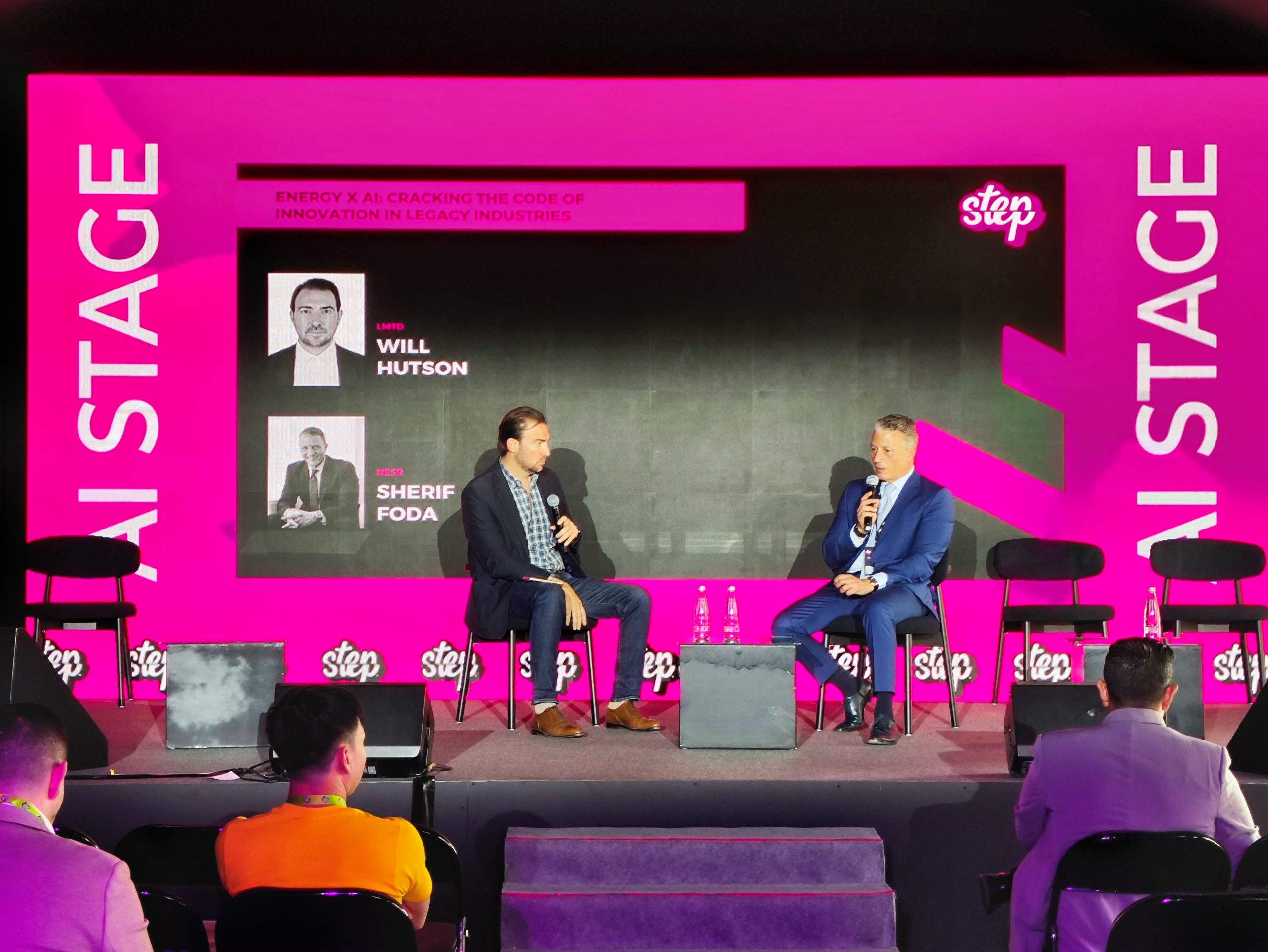
The room at the AI Stage fell into a focused silence as the conversation turned to one of the world’s most complex and capital-intensive industries. At STEP Dubai 2026, the panel “Energy x AI: Cracking the Code of Innovation in Legacy Industries” dismantled the stereotype of oil and gas as digitally sluggish. Instead, speakers painted a picture of rigs powered by real-time analytics, fields monitored by predictive algorithms, and boardrooms increasingly driven by data models.
On stage, Sherif Foda of National Energy Services Reunited (NESR) and Will Hutson of LMTD spoke with urgency about a sector quietly undergoing transformation. Far from being disrupted from the outside, energy is integrating artificial intelligence from within — leveraging decades of industrial expertise and pairing it with machine learning to unlock efficiency, sustainability, and competitive advantage.
At 11:00 am on the AI Stage, the panel challenged the outdated perception that oil and gas lags in digital transformation. The conversation revealed a sector rapidly integrating artificial intelligence to optimize exploration, drilling efficiency, emissions monitoring, and predictive maintenance — proving that legacy infrastructure does not mean legacy thinking.
Sherif Foda, CEO of National Energy Services Reunited (NESR), highlighted how AI is no longer experimental in energy operations. From subsurface data modeling to real-time field optimization, AI is enhancing productivity while driving measurable sustainability gains. He emphasized that competitive advantage in energy now depends on data intelligence as much as physical assets.
Joining him, Will Hutson of LMTD discussed the growing collaboration between startups and established energy players. Rather than disruption through replacement, innovation is emerging through partnership — agile AI ventures working alongside industrial giants to modernize workflows, reduce risk, and unlock operational transparency.
The session ultimately reframed the narrative: energy is not resisting AI — it is actively engineering its integration. As global demand balances sustainability with supply security, the fusion of deep industrial expertise and advanced machine learning may define the next era of responsible energy leadership.